Maria Malievska, Sashko Brynza Photos: Sashko Brynza
Our report from a medical evacuation train used to transport wounded soldiers from frontline hospitals to medical facilities in the rear. The project is a joint initiative of the Medical Forces Command and Ukrainian Railways.
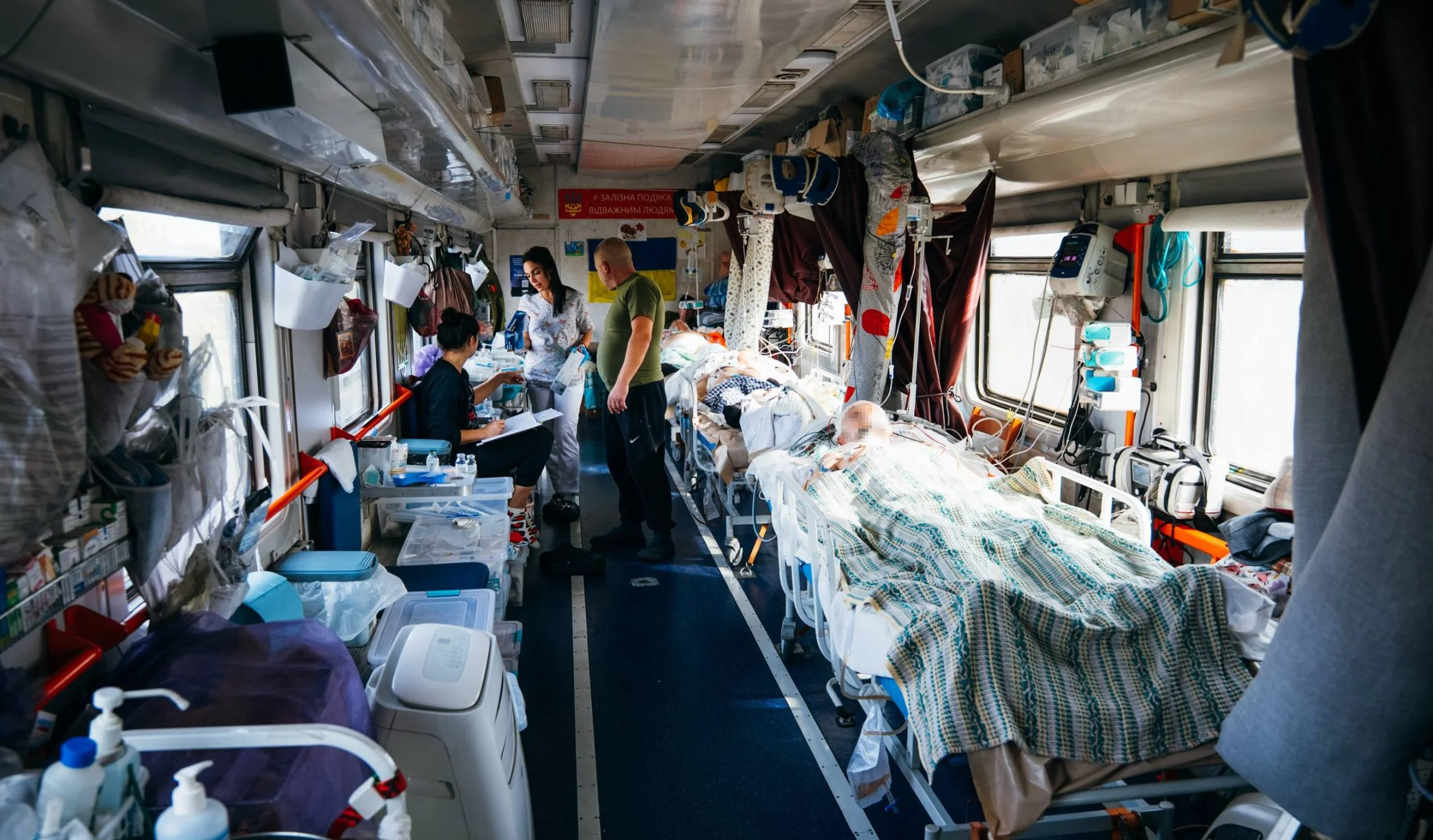
Imagine ordinary train cars you have travelled in many times before, except inside they resemble hospital wards. One of the cars on such trains may function as an intensive care unit. Unconscious wounded soldiers lie here, breathing only because machines breathe for them. Their condition has been stabilised enough to allow transportation.
Who staffs these trains? Is it possible to perform surgery while in motion? How does the work of a nurse in a hospital differ from working in an evacuation carriage? We will ask the medics themselves all of this along the way. Many hours of travel lie ahead. Let us begin.
There is constant movement outside the intensive care unit of a military hospital. In the anaesthesiologists’ hands are small cases — equipment that allows a wounded patient to breathe while being transferred from the intensive care ward to the ambulance.
In the hand of resident physician Inna Timokhina from the hospital’s Department of Anaesthesiology, Resuscitation and Intensive Care is a small oxygen cylinder.
“Severe blast injury with predominant damage to lung tissue. The patient currently has a bronchial blocker in place so that the bleeding does not interfere with breathing.”
The patient is connected to equipment inside the ambulance — and the vehicle carrying the medical team departs. Another ambulance immediately pulls up to the loading platform to collect the next wounded soldier.
We see that it is a young man with amputations of one leg and one arm. We ask permission to get inside and then travel together in the ambulance. The driver turns on the siren.
The wounded soldier’s name is Sashko. He smiles shyly.
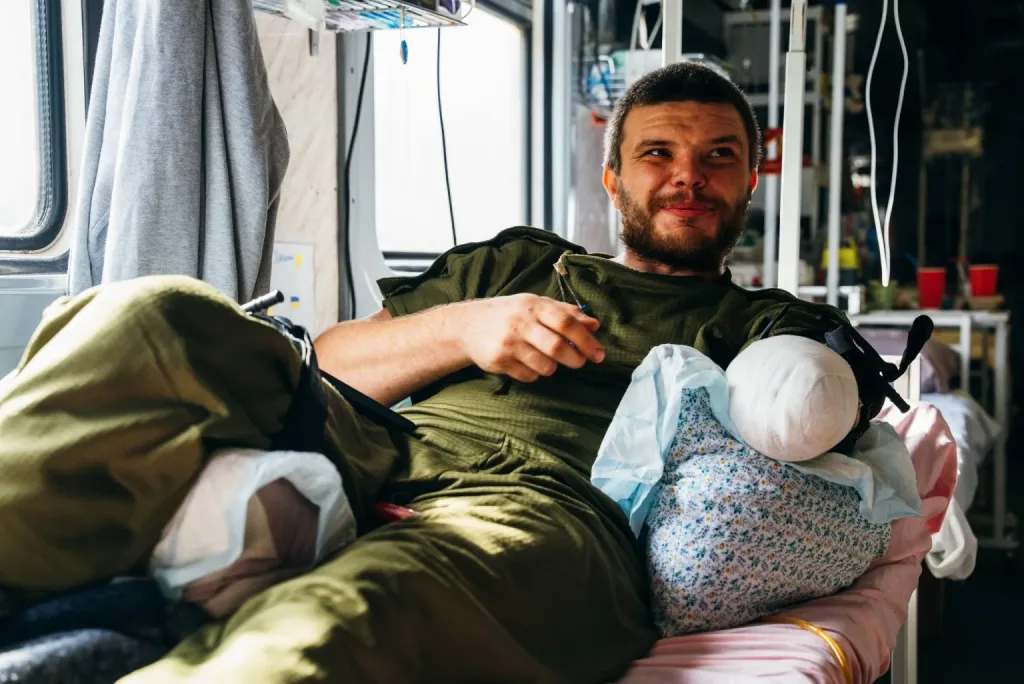
“I stepped on an improvised explosive device. A drone probably dropped it. It was the colour of the ground, the colour of the path I was walking on. I stepped on it even though I was third in line, the last one. The blast threw me to the side. At first, I thought something had been dropped from the sky. I started crawling toward cover — bushes, trees. Then I felt another one with my hand — probably the same thing, though I do not know for sure.
I lay in a dugout for four days. I am grateful to Bohdan. Bohdan, thank you so much. I owe you. We covered four kilometres over three days. I kept saying, ‘I cannot do it anymore, leave me here,’ and he kept saying, ‘No, Sanya, I am not leaving you.’ I owe him.”
“Was he actually carrying you?”
“Yes. On his back. He carried me on his back. We moved along narrow paths. Above us was open sky. Drones were flying overhead — so we kept waiting. Those improvised mines were lying there. I was holding onto him, and he could only look down. I kept telling him: ‘Mine a little to the right. Mine a little to the left.’ And I could feel his legs shaking. I damaged my breathing tube against his body armour. But he carried me and never stopped. I do not know what gave us strength. I stayed in the dugout, in shelter. They put tourniquets on me. I took painkillers. There was a combat medic there.”
“You could not get out because of the drones, right?”
“Yes. Armoured vehicles do not go there at all. To reach the nearest pickup trucks, we had to walk seven to eight kilometres through shelterbelts and fields.”
“How are you feeling now?”
“I am okay. I am not losing heart. The main thing, I think, is not to give up. Life does not stop. You have to keep working and keep living.”
Sashko, like the other passengers today — who are also patients — is transferred directly from the ambulance into the train cars. Medical staff gather around him immediately. They place a special support cushion beneath his amputated leg, check his treatment chart, and hand him yoghurt and a few other snacks.
The carriages are very warm: too warm for ordinary passengers, but exactly the temperature wounded patients need. Each carriage has a doctor, a nurse, and orderlies assigned to it. The train has not even departed yet, and patients are already receiving IV drips and injections.
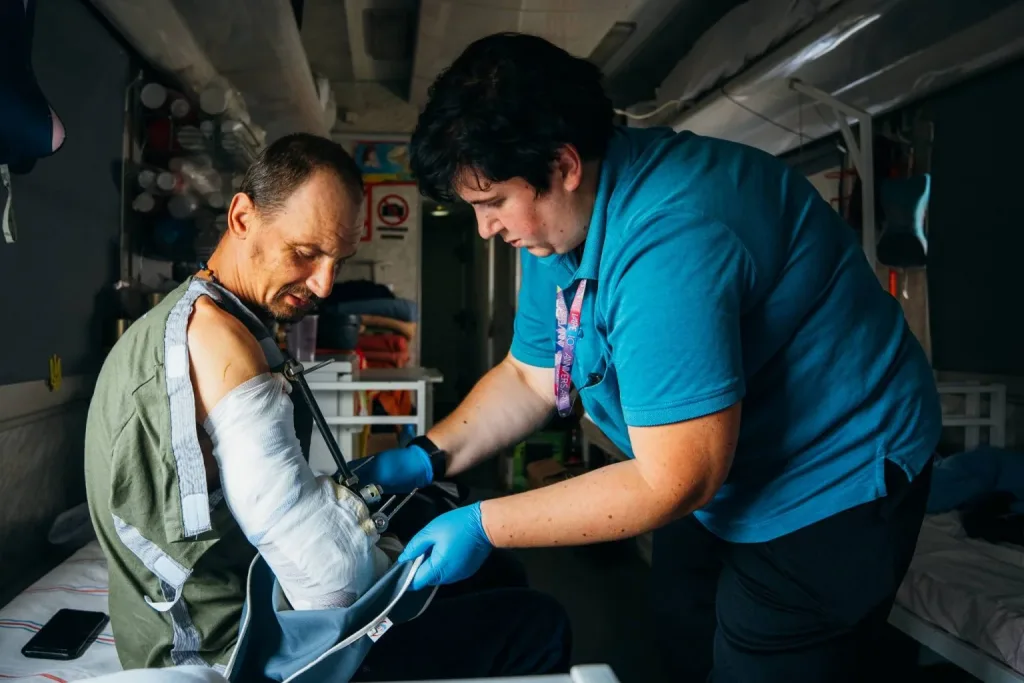
Elena Duda, an anaesthesia nurse on the evacuation train, moves through her carriage, taking patients’ temperatures.
“My job is to deliver the boys safely — without pain — and to continue their treatment, because some patients have just been wounded while others have been injured for longer. And sometimes we even meet again later — sometimes we travel together to rehabilitation too.”
“I can see that you never sit down.”
“No.”
“You are constantly moving from one patient to another. What kinds of situations do you deal with?”
“All kinds. Something as simple as a fever, or something as serious as bleeding — anything can happen. But we are prepared for everything. Everything gets done. You keep moving and watching all the time. Wounds are different. Something may look like a small scratch, but it can lead to serious complications. That is why we monitor constantly. That is why we do not sit down. I have orderlies helping me — they walk around and keep an eye on patients too. If I am here with one patient and they notice something with another, they come quietly, tell me, and we deal with it immediately. Because if one patient suddenly becomes critically ill, I cannot abandon everyone else. My colleagues come over, help, and take care of the other patients.”
“The workload must be enormous.”
“It is. Unfortunately, there are an incredible number of wounded. Physically, though, it does not feel difficult anymore. You somehow get used to it — you find a rhythm and keep going, and going, and going. Sometimes I even think that if somebody gave me time to rest now, I do not know whether I would be able to get back into this pace. Emotionally, though, it can be very difficult. Sometimes you sit down and talk. The boys sometimes need to talk things through, and often we do too. You find someone to talk to and there are moments that become heavy. But otherwise — we are holding up. Especially when we meet several times — then we become like one family. We exchange phone numbers. We all stay in touch.”
Next to our hero Sashko, a child’s drawing hangs on the carriage wall:
“Come home victorious.”
Children’s drawings are everywhere here. And in this carriage, there are soft toys too.
We speak with paramedic Iryna Krasilnykova.
“I see you are hanging drawings on the IV stands, right? Trying to make things feel more comfortable?”
“Yes. We want the wounded defenders to feel warmth and care. They are missing that.”
In one of the train cars we notice an entire display board covered with military patches — gifts from former passengers.
From the vestibule between the cars comes the low hum of a generator. Because railway infrastructure is frequently targeted and power outages are possible, the train has backup power systems. Some of the patients are travelling while connected to mechanical ventilation.
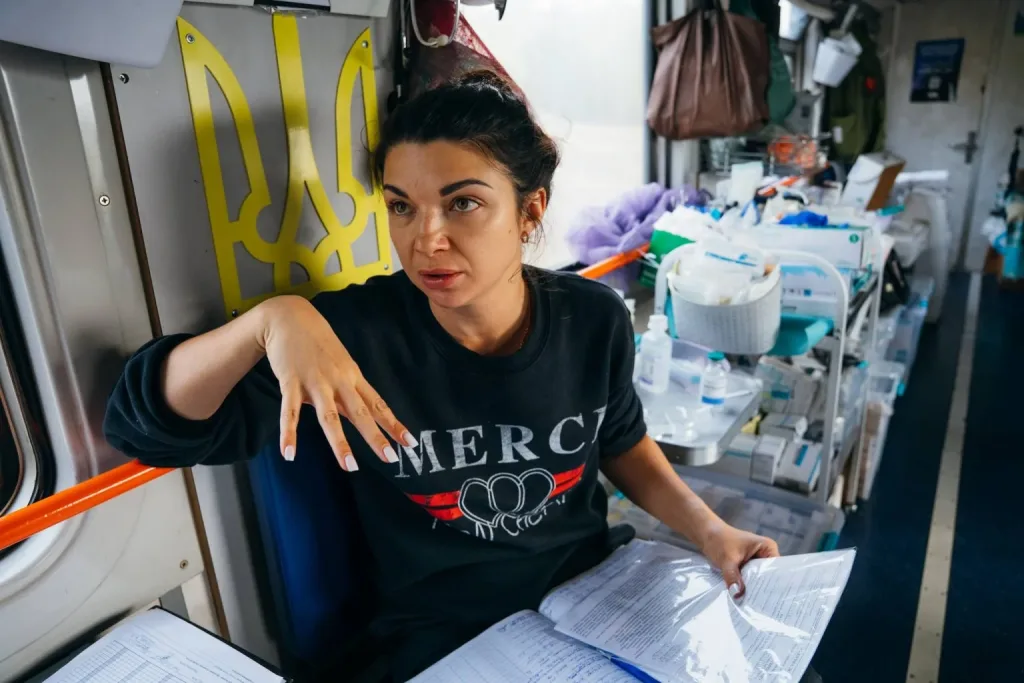
Margarita Danilova, the acting senior nurse of the evacuation train, explains:
“We have an intensive care carriage. That is where the most critical patients are. Mechanically ventilated, sedated — their condition is extremely serious but stable. Our conditions are as close as possible to those in an inpatient department, but there is still movement. We perform procedures while the train rocks and brakes. And unlike in a hospital, you cannot simply transfer a patient elsewhere for additional treatment. In a hospital, you can send a patient for a CT scan, move them to another department, call in more doctors. Here, we are limited to the resources we have — personnel, medical staff, medications.”
“When a patient arrives, we assess their condition. If our doctors are not comfortable with it, they will not risk that patient’s life. Better to prepare them, stabilise them a little more, continue treatment — and then collect them next time. We do not transport patients in critical condition. Because this is someone’s life. These are our defenders. Anything can happen on the road. It is travel. It is the human body. But thank God, so far everything has gone well. I hope it stays that way.”
We get a chance to see for ourselves what it means to perform medical procedures while the train sways from side to side. We observe an anaesthesia nurse Mariia Savitska as she moves from one critically injured patient to the next.
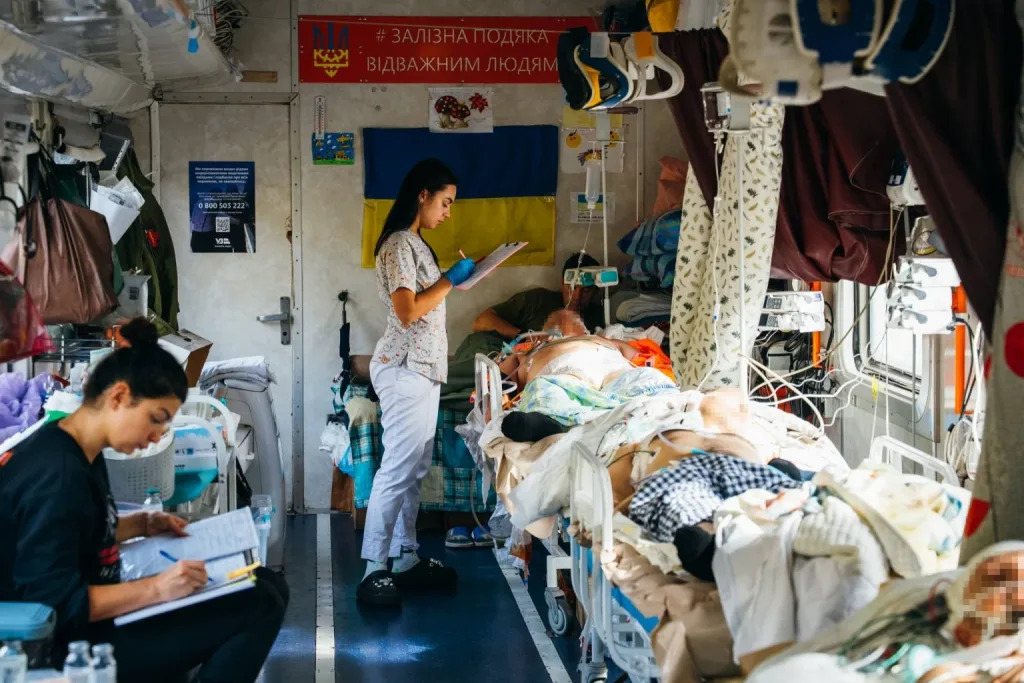
“The hardest part is when the train is moving and you still have to work. That is the most difficult thing — the train moves, and it can pull you to the left or throw you to the right. You have to keep yourself steady to perform procedures correctly and make sure you do not harm the patient, so that everything stays all right.”
“Have you developed any tricks for staying on your feet?”
“One foot forward, one foot back — that makes it easier. You need proper balance on the leg you are standing on. Physically, it is difficult when there are severely wounded patients. When many of the boys are on mechanical ventilation and there is so much work that you barely have time to change syringes on the infusion pumps. Emotionally, though, I have already adapted.”
“Did you volunteer for this work?”
“Yes. I enlisted.”
“How long ago?”
“Three years ago, on the seventeenth of October.”
“You simply went to the recruitment office and said you were an anaesthesia nurse?”
“Yes.”
The person in charge of the intensive care carriage, Yurii Vasylets, is a young man. Here, he serves as a resident physician on the evacuation train. Before joining the service, he worked as a doctor at one of Kyiv’s most well-known private clinics.
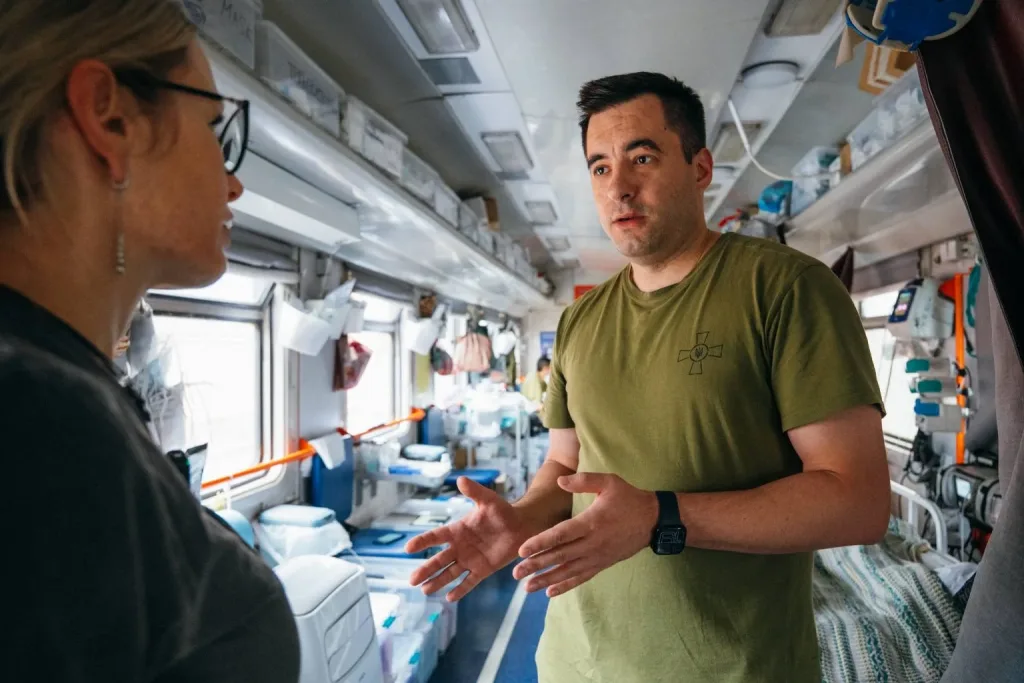
“Today we are transporting critically injured patients. Eleven of them — the majority — are on mechanical ventilation. Most are patients with traumatic brain injuries who require oxygen support. At this moment they are haemodynamically stable.
Patients also often require monitoring and support of haemodynamic function. We try to transport only stable patients because long journeys increase risks. Our goal is not simply to move the wounded from one place to another. Our goal is to provide care and avoid harming them during transport.”
“So in practice, treatment never stops — during all these hours on the road, patients continue receiving care?”
“The doctors who hand patients over specify in the discharge notes which medications and treatments were being administered. We continue that treatment. We make sure that the key medications patients received at earlier stages continue to be administered during our stage of care. We have had cases of cardiopulmonary resuscitation onboard.
In such situations, we transfer the patient as quickly as possible to the nearest treatment stage for stabilisation — meaning we stop at the nearest available point.”
“I think the work we do is simply medicine. We are used to working in this mode. The difficult part is being away from home for long periods. Away from colleagues, away from continuous professional development. A lot of people start wondering whether everyone has forgotten about us here on this train — and whether all we do now is keep moving. Where are we moving? What comes next?”
“Tell me honestly — how many days a month are you actually home?”
“Four or five days. And compared with military personnel, many of them do not even have those four or five days. Everyone needs rest. People are tired.”
By evening, passengers will be served hot soup. Most of them will sleep through the journey.
Patients with lighter injuries will spend the trip speaking with their families over video calls.
And accompanied by the same sounds of machines breathing in place of the wounded, they will later be carried out of the train cars into ambulances and dispersed among rear-area medical facilities.
Our hero Sashko, living now with two amputations, smiles as he says goodbye.
“What can I say? Life does not end here. For some people, this is the beginning of a second life. You can start over, or you can continue serving — that is each person’s choice. I believe there is something worth living for. We are not riding in this carriage for nothing. We are riding so we can keep living. I still plan to play football. I love football. I have seen there are different foundations and programmes. I think I will get back out there and play.”
This document was produced with the financial support of the European Union. The contents of this document are the sole responsibility of Radio Nakypilo and can under no circumstances be regarded as reflecting the position of the European Union.