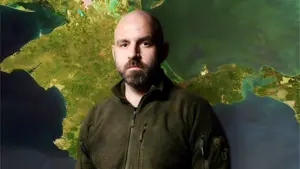
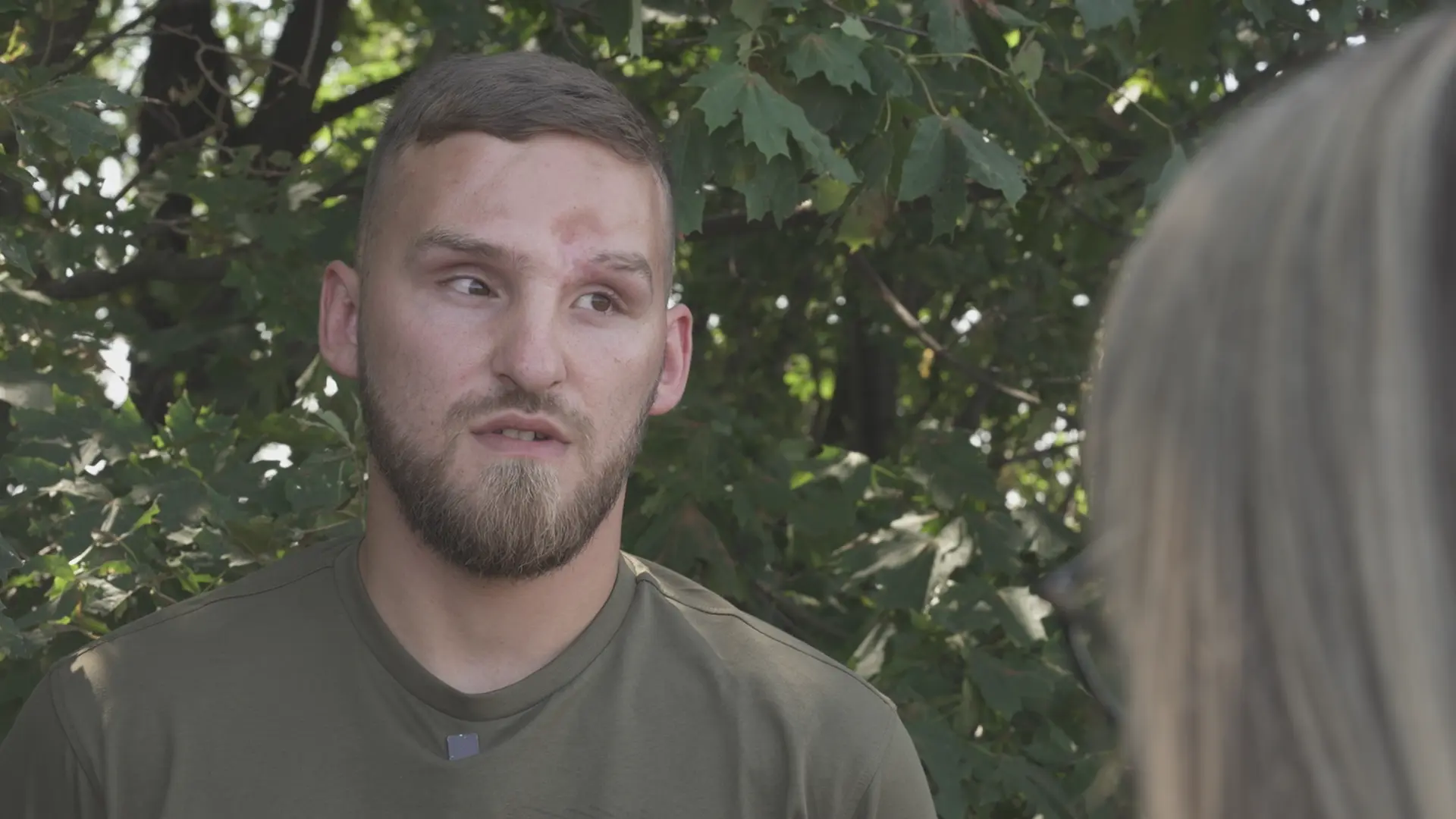
Mikhail, callsign Skhidnyi (“Eastern”), has a story that feels almost impossible. Not only because he somehow survived after taking a bullet to the forehead. His story sounds like something out of a film for another reason too: just a few months after such an extremely severe injury, the fighter returned to service and is now fighting on the Pokrovsk axis of the front.
The bullet struck him in the forehead, and then — in some way that still seems impossible to explain — he inhaled it into his lungs. The wound left a mark on his face, but it did not stop his determination to drive the Russians out of his native Donetsk region.
The unit where Skhidnyi serves is the First Separate Assault Regiment. The latest episode of the Derzhprom Station podcast is dedicated to them.
“Yes, I carry out combat missions, and I also train newly arrived guys who want to become specialists in piloting FPV drones.”
Mikhail, callsign Skhidnyi, is twenty-five years old. He is behind the wheel. Together with several other fighters, they are driving out to train. Out in the field, the soldiers set up special rings to practice maneuvering drones. Within fifteen minutes, the air fills with buzzing. Future pilots are learning to operate UAVs.
While the newcomers prepare, we ask Mikhail — their instructor for today — about how the enemy is behaving on this section of the front.
“Right now, fiber-optic drones — which cannot be jammed by anything — are being used extensively by both us and the enemy. Because of that, the enemy relies more on infantry units and small groups. As you can see in the news — and this is no secret — they sometimes break through into rear areas and manage to advance. Then entire operations have to be carried out to clear them out and contain them.
Fiber-optic drones are evolving too. Their range and functionality keep increasing. We improve ours, and unfortunately the enemy improves theirs as well. At the moment, this is the biggest problem.
The enemy also uses drones as ‘waiters’. Those drones sit along logistics routes and roads, waiting for personnel deliveries or troop rotations. I think most losses right now come from drones like these.
And we inflict the greatest losses on the enemy through unmanned systems as well. Both they and we create so-called kill zones stretching five to ten kilometers. It’s extremely difficult to get through thre in a vehicle or even on foot.”
Mikhail received his severe injury a year ago, in the autumn of 2024. At that point, he had been carrying out combat missions as an FPV drone operator for only two months, yet he was already a crew commander. It happened in the Kurakhove–Vuhledar area. You may have heard about those events in the news as the Uspenivka pocket.
“Overall, the fighting was extremely heavy because every day the enemy launched large-scale assaults involving significant amounts of armored vehicles. Every day we destroyed a lot of equipment and personnel. But because the enemy advanced on the flanks, there was a risk they could deliver a painful strike from the side.
And that’s exactly what happened. An enemy column broke directly into our tree line, where our position was located. We had prepared for the possibility. We had to engage in close-range small-arms combat with the enemy.
There were three people at the position: me, as crew commander and pilot, and two of my brothers-in-arms who were also working there. I was the first to engage because the enemy came close. Three Russian assault troops appeared right above me, about two meters away. I opened fire at them, and then suddenly I was stunned.
I lost consciousness for some time. I thought it was an explosion — that they had thrown a grenade.”
He crawled into the dugout where his comrades were.
“I tried to give myself medical aid. I couldn’t understand where I was wounded — my head just hurt and rang. My comrades said: ‘Don’t touch your head. You have a head wound.’
I remained conscious the entire time at the position. Several hours passed before evacuation because fighting was still going on around us — the enemy was being eliminated. Then our reconnaissance guys came to get us.”
— There wasn’t much bleeding?
“There was, but not critical. Otherwise I would have died.
If an artery had been damaged, I wouldn’t have survived because you can’t apply a tourniquet to the head. So I was lucky there wasn’t any catastrophic bleeding. Just a concussion.
Between surgeries, while they were moving me on stretchers, I heard doctors talking. They said to each other: ‘We’ve finished with the head, now we’ll remove the bullet from the lungs.’ And I’m lying there thinking: ‘What bullet? What lungs? I have a head wound.’
But it turned out the bullet entered at an angle through the sinus cavity, dropped down, and I inhaled it into my bronchi. They removed the bullet with a magnetic probe. That was the end of the major surgeries.”
A month after the injury, Skhidnyi recalls, he was already walking on his own. His mother came to Vinnytsia to support him during rehabilitation. His parents, Mikhail says, are his greatest support. His family lives in one of the towns in Donetsk region that the front is now approaching.
“The bullet entered at an angle. If it had gone differently, I’d be dead. If it had gone near the temple, I’d also be dead because it would have entered the brain — and that would’ve been bad. People usually don’t survive gunshot wounds like this. I was lucky it entered at an angle, hit thick bone, and stopped. It was a 5.45 mm round, not 7.62. 7.62 is slightly larger and more destructive. Most likely I wouldn’t have been this lucky with a different caliber. I still don’t know. I didn’t even feel myself inhaling. That shocked me too. Between surgeries I would briefly come around and hear doctors talking.
When I fully regained consciousness, my brothers-in-arms and commanders came after the operation and told me how the battle ended. Because I had no idea what happened or what kind of injury I had.”
— You could have chosen not to return. The medical commission could have discharged you?
“Yes. The military medical commission declared me unfit for military service.”
— But you came back.
“Yes, I came back.
I also recently received third-group disability status. I returned because when I joined the Armed Forces, I was deeply motivated to destroy the enemy. I’ve lived in Donetsk region my entire life. My homeland has suffered from the enemy, from Russian occupiers, since 2014. In 2014, I was under occupation. Thanks to the Armed Forces, we were liberated fairly quickly — after three months. So I’ve known for a long time what the ‘Russian world’ means, and I oppose it.
I decided that until the war ends, I will help the army however I can and continue taking part in combat operations. I’ll do everything possible so this ends here, on my land, in Ukraine, so we don’t have to suffer from it.”
“While recovering after the injury, I felt and knew that I could still be useful in the Armed Forces. I didn’t know how far rehabilitation would take me, whether I’d be able to return to combat missions or end up in some rear position. But I knew it, and I told my parents. They fully support me. Of course, maybe all of this was hard for them. But they accepted it.”
So after rehabilitation and medical leave, at the end of February, he returned to the unit. A month later he was officially declared unfit for service. But under current law, with the consent of a unit commander, service can continue in certain positions. As it turned out, after his injury he was even able to take part in combat operations again. From the end of March through the end of June, he returned to missions as part of a crew. By the end of June, they had begun expanding into an Unmanned Systems Battalion.
Those interested in serving in the Unmanned Systems Battalion can submit an application through the unit’s website or contact the regiment’s recruiters directly without going through the TCC. Recruiters can be reached at: +38 (093) 697-93-44 or +38 (066) 724-01-33.
Maria Malievska and Sashko Brynza
Radio Nakypilo expresses gratitude for the financial support of the European Union through the project “Support for Frontline Media and Investigative Journalism,” implemented by Internews International in partnership with the NGO Media Development Foundation (MDF). Radio Nakypilo maintains full editorial independence, and the information provided does not necessarily reflect the position of the European Union, Internews International, or MDF.