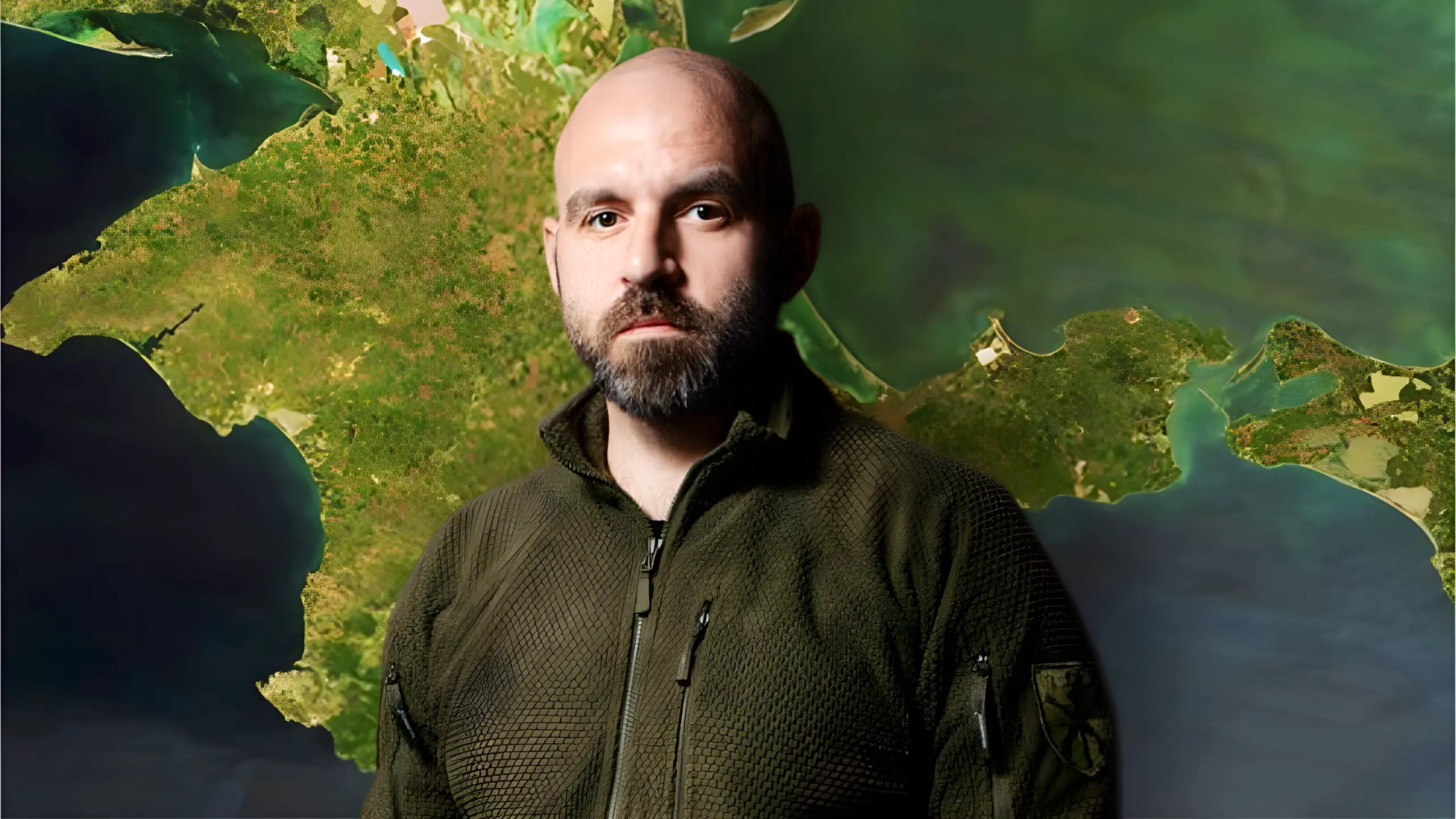
On February 26, Ukraine marks the Day of Crimean Resistance to russian occupation. On this day in 2014, a large pro-Ukrainian rally took place in Simferopol, opposed by pro-russian forces. Radio “Nakypilo” spoke with Ukrainian journalist and Armed Forces sergeant Pavlo Kazarin. The interview explored Crimea’s past and future, Ukrainian flags on the peninsula, and why Ukraine had long overlooked Crimea.
You were born and raised in Crimea. Tell us about your personal experience. What kind of mix of people surrounded you on the peninsula? How did they all coexist?
I belonged to a generation of Crimeans who grew up alongside Crimean Tatars. When I started school, there was a boy in my class named Dilyaver. So we were part of a generation for whom Crimean Tatars were always present. This was different from our parents’ generation. For them Crimean Tatars were a separate reality. Something people tried not to mention or remember. And if they did, it was usually in the context of accusations of “betrayal” during World War II.
In general, it’s important to understand that in the 1990s, the 2000s, and even later, Crimea was the most pro-soviet region of Ukraine. It wasn’t so much “pro-russian” as it was “pro-soviet.” People there had never really experienced russia itself or its everyday realities. For many Crimeans, their perception of russia came from occasional trips to places like saint petersburg or moscow. As a result, the dominant discourse in Crimea was shaped by pro-soviet narratives. In this sense, the peninsula reminded the sinners in Dante, walking forward with their heads turned backward. The electoral landscape reflected this.
Pro-soviet forces consistently won the majority of votes in local elections. In the 1990s, the Communist Party dominated this space. Later, various pro-russian parties took over, including the Party of Regions. Crimean Tatars, on the other hand, were the most pro-Ukrainian group in a largely pro-soviet Crimea. They could not accept the ethics and aesthetics of the state that had deported them and prevented them from returning home for forty years. Politically, they were always the drivers of pro-Ukrainian, national-democratic movements in Crimea. They ran on the lists of national-democratic parties, mostly voted for them, and remained somewhat apart from the broader political processes on the peninsula.
You say that there was a strong attachment to the soviet past on the peninsula, yet in 1991, 54% of voters in Crimea supported Ukraine’s independence. Was it because Crimea was one of the most prestigious resorts in the 1970s, and so people later longed for that time?
First of all, we shouldn’t be misled by the results of the 1991 independence referendum in different regions of Ukraine. In some regions, people voted for independence because they genuinely wanted it and sought to break away from the empire. But many people in the Ukrainian SSR went to the polls and voted for independence because they saw it as a way to stop subsidizing other soviet republics. At the time, there was a widespread belief that Ukraine was a donor within the soviet union. Many thought its resources were being taken and redistributed to less self-sufficient republics. For many, then, voting for independence was not about changing the socio-political system. It was not about a cultural shift, nor about rethinking soviet everyday life and practices. It was seen instead as a path to rapid economic improvement. This idea was quite popular — even in Sevastopol, more than 50% voted for independence. But that does not mean all those people viewed their choice as a step toward genuine, rather than merely nominal, independence.
The second part of your question concerns pro-soviet sentiment. To understand it, we need to consider the role Crimea played in the USSR. It was the most popular seaside resort — even more sought-after than the krasnodar region or sochi. Under the conditions of the Iron Curtain, the region perceived itself as something of a paradise on earth. After the Iron Curtain fell, people saw new places and realized that Crimea’s southern coast wasn’t the only beautiful place in the world. As a result, many in Crimea came to see the 1970s–1980s as the peninsula’s “golden age.” They began to long for that period — both for the region itself and, perhaps, for their own social status as residents of such a place. This, in part, gave rise to pro-soviet nostalgia.
At the same time, many people with a soviet mindset struggled to accept that they were now living in an independent Ukraine. It was a country with its own view of history and its own vision of the future. In that sense, pro-soviet sentiment was, on the one hand, an expression of nostalgia for the past. On the other hand, it was a form of resistance to a reality they were not always ready to accept, engage with, or fully understand.
Was this the case across all of Crimea — that people always saw themselves as separate from Ukraine?
In general, it’s important to understand that Ukraine has had several strong regional identities. We often talk about Galicia as a region with its own distinct identity. Odesa is known for its strong urban identity, and Kharkiv has one as well. Before 2014, Donetsk clearly had its own identity too. In Crimea, however, there were actually two. Sevastopol had a separate identity of its own — people there would say, “You are Crimeans, and we are Sevastopol residents.” And then there was the identity of the peninsula itself.
I think even in 2013, if you asked people in Crimea how they identified, most wouldn’t answer in ethnic terms. They wouldn’t say russian or Ukrainian. Instead, they would have responded in regional terms. Most likely, they would have said they felt Crimean. Despite being a peninsula, Crimea had a very strong “island-like” identity. This can sometimes happen simply due to geography. In Crimea, geography and history worked together. The peninsula was separated from the mainland. Social and historical factors further reinforced this separation.
When I was in Crimea, I was struck by how much of everything there was russian. Being a russian sailor seemed more prestigious than being a Ukrainian one. Concerts, russian TV, the entire agenda — it all felt russian. So this raises a question: what did Ukraine miss in its policy toward Crimea? What should it have done, and why did things develop this way?
First of all, we shouldn’t think that Ukraine and russia started from equal positions in Crimea when competing for public attention and support. russia, as the ideological successor of the soviet union, clearly had a major advantage.
All the social factors we mentioned were reflected in culture as well. For example, the Ukrainian band Okean Elzy could fill a concert hall in Simferopol’s music college. Meanwhile, the russian band DDT could fill the Lokomotiv stadium in the same city. Honestly, it would have been surprising if Crimea had developed a different cultural direction, given the circumstances we discussed earlier. That’s why there was strong demand for russian performers.
As for social prestige, it’s important to understand that even in the 1990s — and especially in the 2000s — russia was much wealthier than Ukraine. Because of that, serving or working with the russian Black Sea Fleet was seen as more prestigious than serving in the Ukrainian Navy. Salaries were higher. Social benefits were better. Conditions were more comfortable. For the same reason, working on a russian civilian ship was considered more prestigious than being part of a Ukrainian crew. This came down to one simple factor: russia had more money, while Ukraine had far fewer resources.
They just invested a lot of money, as I understand it?
They simply had that money.
So what exactly did Ukraine miss in its policy? Could we have done something to make Crimea more pro-Ukrainian?
When we say that Ukraine should have acted differently in the past, we are probably looking at it through today’s lens. When we look back now, we see the Ukraine that exists today. It’s a country where “Glory to Ukraine!” is an official greeting in the armed forces and the police. Where celebrating the birthday of Stepan Bandera is seen as a normal expression of civic position. Where speaking Ukrainian in public reflects a certain cultural awareness. But it would be a mistake to think that Ukraine in the 1990s, 2000s, or even the 2010s was like this.
Back then, Ukraine was going through a major internal transformation. It was, in a way, trying to build and spread itself within itself. The question wasn’t only how to win the support of people in Crimea. It was also how to win the support of people in Kyiv, Chernihiv, Poltava, Dnipropetrovsk, Kharkiv, and other cities. For many years, Ukraine was not a country where the mainland had a shared vision of its past and future, with Crimea as the only exception. On the contrary, it was a country in constant internal diffusion. Ukraine was trying to define and establish itself every single day. That’s why we need to be careful with our terms. When we ask whether Ukraine could have done something differently, we should first remember what kind of country Ukraine actually was at that time.
Can we say that Ukraine lost Crimea because it struggled for a long time to fully become a state?
The loss of Crimea was caused by a lack of resources. This gap emerged after years of pressure on Ukrainian statehood by the Party of Regions and pro-Soviet political forces. It was also caused by a collapse of governance and legitimacy. This happened after Viktor Yanukovych fled Ukraine in late February 2014.
If we compare the occupation of Donbas and the annexation of Crimea, why didn’t russia create a separate republic in Crimea? Why is there no “Crimean People’s Republic”?
I think it’s because Crimea was much more embedded in russia’s political and cultural consciousness. There are geographic maps, and there are mental maps. Mental maps reflect how people imagine the “correct” borders of their country. For example, the mental borders of the russian federation have always been larger than its actual borders. Many people were used to thinking of Crimea as unquestionably theirs. The same applied to places like Riga, Vilnius, Tallinn, or northern Kazakhstan. In that sense, places in Crimea were already part of russian cultural memory. Bakhchisarai was linked to Alexander Pushkin, who wrote The Fountain of Bakhchisarai. Yalta was associated with Anton Chekhov, who lived and worked there. Sevastopol was deeply embedded in russian memory through two major defenses — the Crimean War (1854–1856) and World War II. Kerch, known as a hero city, was tied to the memory of the Adzhimushkay quarries. So Crimea itself lived within these russian myths. And russia, in turn, also lived within them.
At the same time, Crimea was barely present on Ukraine’s mental map. If we look at Ukraine’s mental map in the 2010s, we clearly see Kyiv as the capital. We see Lviv. We see Poltava as the birthplace of the Ukrainian literary language. We see Chernihiv as one of the oldest cities. But whether Crimea truly existed on that map is an open question. I’m not sure the answer would be yes.
As for the difference in Crimea and Donbas fates. We have to understand, that Donetsk and Luhansk were not part of russian cultural mythology. Places like Bakhchisarai and Sevastopol were present on russia’s mental map. Cities like Horlivka or Sievierodonetsk were not. That’s why, for the russian collective imagination, the “return” of Crimea felt like a major historical event. It resonated emotionally with many people. The annexation of a city like Makiivka would not have had the same effect. So, I think the russian leadership decided that Crimea’s future would be annexation. At the same time, Donetsk and Luhansk would remain under occupation.
So does that mean Donbas was on Ukraine’s mental map after all?
I think it was more present on Ukraine’s mental map than on russia’s. We should also understand that Donbas was, in part, a way for russia to shift attention away from Crimea. It was also meant to destabilize Ukraine. Overall, its role — both in 2014 and later — was mainly instrumental. You can see it even now. Everyday life in Crimea is much more comfortable than in Donetsk or Luhansk. This shows that Donetsk and Luhansk rather tools for the russian leadership. They didn`t have the sacral importance that Crimea had.
Until 2016, Crimeans received certain subsidies. What is the situation now?
I followed the situation in Crimea until around 2017, and then I stepped away from the topic. But it’s important to understand that the views of Crimeans were never decisive in shaping Crimea’s future. They were not the architects of what happened. They were more like observers. The main — and only — actor in Crimea in 2014 was the russian federation. Even if tomorrow 90% of people in Crimea were unhappy with their situation and quality of life, it wouldn’t change anything. The russian federation is a state where statism dominates. The only real actor is the state itself.
I’ve watched many interviews and read a lot on the topic. In one of interviews, someone asked what Ukraine needs to do to return Crimea. One of the answers was that we just need to wait until people there want to come back themselves. So does that mean it’s impossible?
That’s an illusion that has existed since 2014. Many of us who were forced to leave Crimea have written about this. The reason is simple: Crimeans are not the ones deciding their own fate. De-occupation happens by the same rules as occupation — through armed force. The Ukrainian flag will stand where Ukrainian soldiers stand.
So does that mean Crimea can only be returned by force?
I don’t really believe that the russian federation will willingly give up its territorial gains. This simply isn’t part of its political tradition. History shows that it has never voluntarily given up territory. It has only lost territory either through war or through internal crises. In such cases, regions with enough strength and agency were able to break away and defend that choice. The de-occupation of Ukrainian territory will happen in one of two ways. It will come through war and the strength of the Ukrainian state. Or it will come through the weakness of russia. Internal instability may make it unable to hold what it has taken.
What should Ukraine’s policy in Crimea be once the peninsula is returned?
We have to understand that if a window of opportunity opens to bring Ukrainian flags back to Crimea, the region will be in crisis. It will likely face shortages of food, security, and basic resources. This window will only open when the russian federation is in serious decline. At that point, it will no longer be able to provide even the basic levels of the Maslow hierarchy of needs for the people it considers its citizens.
This won’t be a situation where someone simply hands Ukraine the keys to Crimea. We won’t be dealing with today’s population in its current state of mind. It’s like comparing russia in 1913 and 1917, or 1980 and 1991.
These are completely different states of society. At the same time, I don’t think Crimea is something Ukraine can focus on right now. We are in the middle of a very intense military confrontation. The main goal of this war is to preserve statehood and sovereignty. If we manage to protect both, then in the future we may have a window of opportunity to think about territories that were occupied eleven years ago. For now, we have far more urgent priorities.
Still, if this does happen and Ukrainian flags return to Crimea, how should Ukraine approach its policy there? How can it encourage more pro-Ukrainian attitudes? And how strongly pro-russian are people there today?
I have no clear idea what kind of historical processes will accompany the return of Ukrainian flags to Crimea. It could happen through fighting, forcing many people with a pro-russian identity to leave and move to russia. Or it could be the result of a major internal collapse in the russian federation. In that case, many people would look for anyone who could provide basic needs in exchange for loyalty. It could be anything. Predicting what kind of population, attitudes, and conditions we will face is very difficult.
If we talk about Crimea in 2013–2014, were there pro-Ukrainian attitudes?
I think that at the time, about 40% of people in Crimea had a strongly pro-russian identity. No more than that. Around 20% identified as pro-Ukrainian. And about 40% were mostly focused on everyday survival rather than politics or flags.
Many pro-Soviet residents of Crimea were deeply frightened by the events of the Maidan. They mainly consumed information from russian media. We can imagine how those media portrayed the Revolution of Dignity. Because of that, those 40% focused on survival could temporarily align with pro-Soviet views. Some felt their identity was under threat. Others believed that a Maidan victory would create risks for their everyday lives.
Of course, there are still people in Crimea who hold pro-Ukrainian views and identity. But I wouldn’t overestimate their numbers. And I also don’t think that returning any territory after more than ten years of occupation can be a self-balancing social process. It will require outside intervention and major effort.
I now live in Kharkiv, in a Ukrainian-speaking bubble. It feels to me that the Ukrainian language is actually quite easy to learn. Also a Ukrainian identity can form even under russian missile attacks. Could this happen in Crimea?
For eleven years, this region — which was never the most pro-Ukrainian to begin with — has been living under the rules of the russian federation. That state presents Ukraine as one of its main existential enemies. So when you talk about returning to the Ukrainian language space, I would remind you that it first requires a return to the mental space. If a territory remains occupied long enough, it can eventually forget its past.
That sounds both alarming and hopeful. So if we do manage to return it, does that mean there is still a chance?
We live in a country that has proven more than once that the impossible is possible. If in the 1960s people had started seriously talking about Ukrainian independence, it would have sounded like wishful thinking to most people living in the Ukrainian SSR. At the same time, this principle can sometimes work both ways.
Author: Tetiana Khoronzhuk