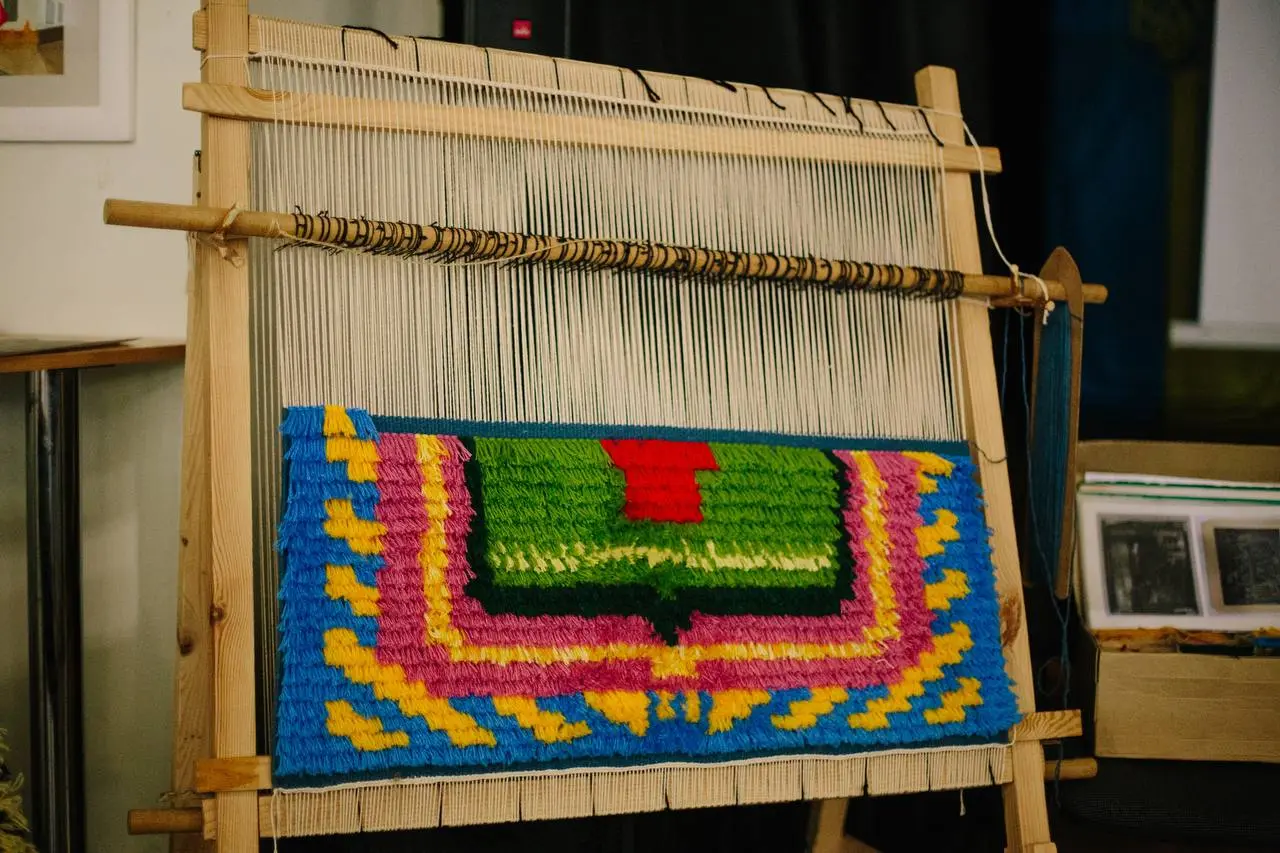
Many Ukrainians know little about the traditional culture of Slobozhanshchyna. We might be familiar with the Krolevets towel, pysanky, traditional songs, folk jewelry and clothing, or what old houses looked like. But did you know that for about five years now, researchers and craftspeople have been working to revive and popularize Kharkiv kotsy weaving—a traditional form of knotted long-pile weaving, used to create distinctive carpets known as kotsy—a craft that was once a widespread local trade in the 18th–19th centuries?
A year ago, the technology of making Kharkiv kotsy was recognized as an element of Ukraine’s national intangible cultural heritage.
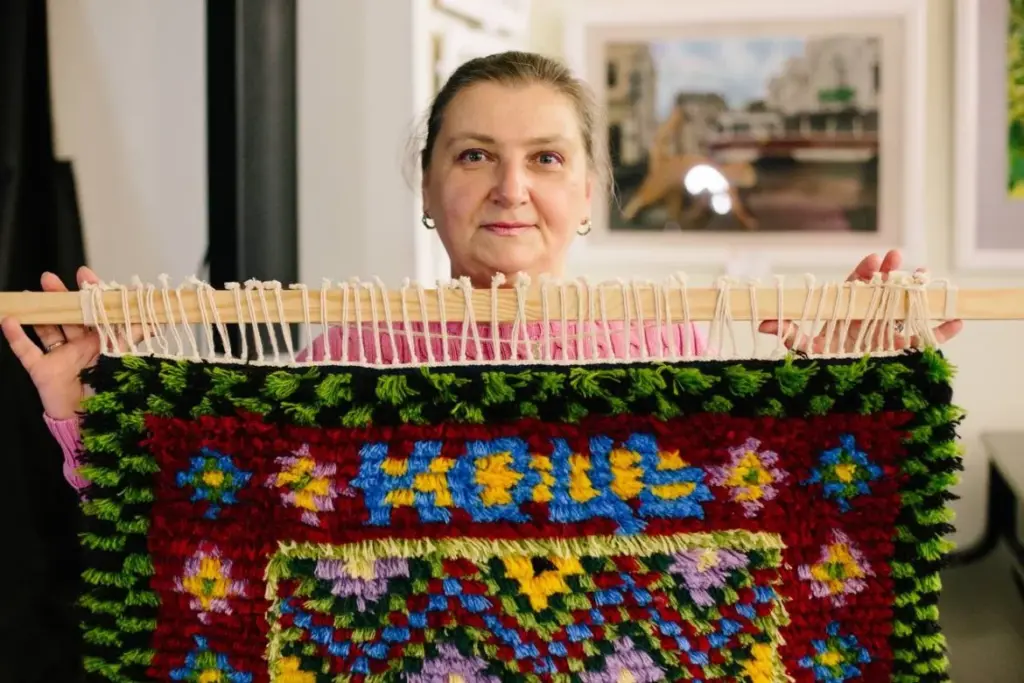
We spoke about this technique, the kotsy themselves, and the tradition of kotsy weaving in the Kharkiv region with Iryna Shehda, a hereditary Kharkiv kotsy weaver.
— Ms. Iryna, Kharkiv kotsy weaving—the technique of making kotsy—was added to the National List of Intangible Cultural Heritage of Ukraine in 2022. What makes it unique?
— First of all, it’s important to emphasize that “traditional Kharkiv kotsy weaving” is intangible cultural heritage. We are not talking about the kots itself as an object, but about the craft—the knowledge and practices behind its creation. It is a unique weaving technique on a vertical loom, likely found only in the Kharkiv region. We have documented it and are doing everything we can to preserve and promote it so that it becomes clearly associated with our region.
— Could you tell us more about this technique?
— To begin with, it’s important to understand what distinguishes a kots from other long-pile carpets. In most such carpets, each row is beaten in with one or two weft rows. In a kots, however, there is a full smooth band—about one to three centimeters wide—depending on the pile length and the maker’s intention. This smooth woven band is a defining feature of the kots.
Kotsy can be woven on different types of looms—horizontal, vertical, and others. Our loom, by the way, is called a “razbiei” (or “rozboi”). It is also a vertical frame, like Poltava looms, but instead of standing independently, it leans against a wall. It is collapsible: when not in use, it can be stored as four wooden slats in a corner or attic without taking up much space. Even when assembled, it remains compact—unlike a horizontal loom, which can occupy half a room or more.
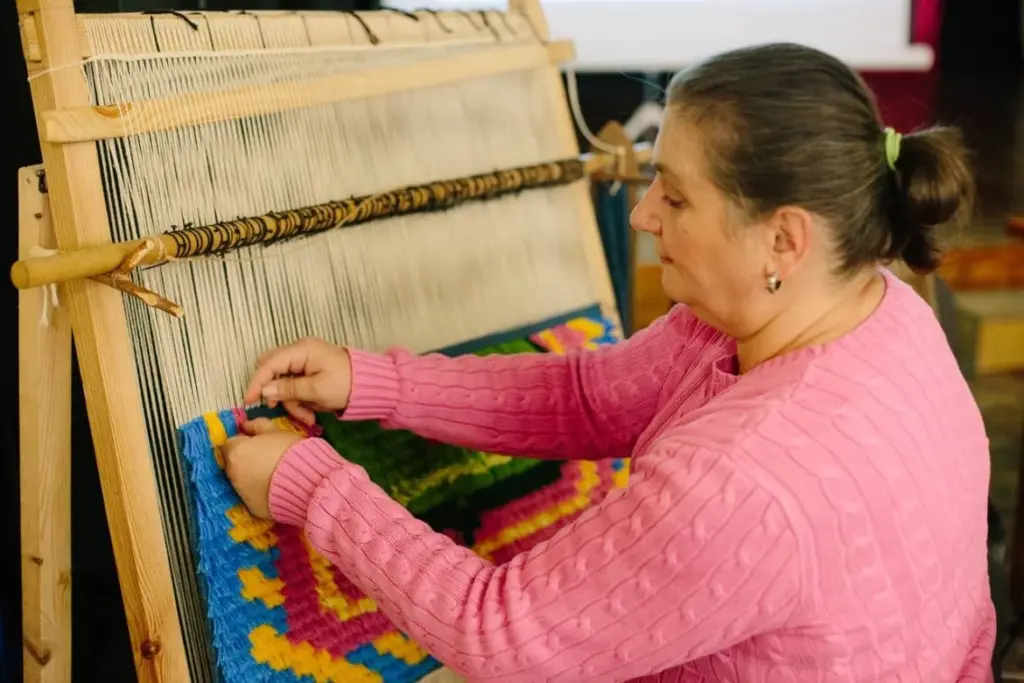
This loom was very practical. It allowed weaving fabric up to three meters wide, whereas horizontal looms typically produced pieces no wider than fifty centimeters, which then had to be sewn together. Our weaving technique makes it possible to create a kots as a single piece.
As for the weaving specifics, the pile knots are tied in the same way as in most carpets from other regions—using a double knot. However, the plain weave is formed slightly differently on our loom compared to other vertical looms.
In addition to the frame, we always use three rods. Two are called the upper and lower “throwing sticks.” The entire warp is wound onto the lower one, while paired warp threads are tied to the upper one, which also participates in the weaving process. The third rod is called the “prysuvalnia,” and the unpaired warp threads are looped over it.
The prysuvalnia and the upper throwing stick are used to create the shed for the weft. When the prysuvalnia is moved downward toward the upper stick, it opens the odd shed for passing the weft thread. After that, the rod returns to its original position. Then, by placing the upper stick onto the side supports (“forks”), the even threads are brought forward, opening the even shed for the shuttle. By alternating these actions—working with the prysuvalnia, the upper stick, and the shuttle—the plain weave is formed.
All these terms are part of the loom’s unique vocabulary. This is also our cultural asset, as such terminology is not known to be used elsewhere. These names were preserved thanks to early 20th-century research on kotsy weaving by ethnographer Vasyl Babenko. Later, much of this knowledge was lost: “razbiei” came to be called simply “a vertical frame leaning against a wall,” and kotsy were described as “shaggy bedside rugs.”
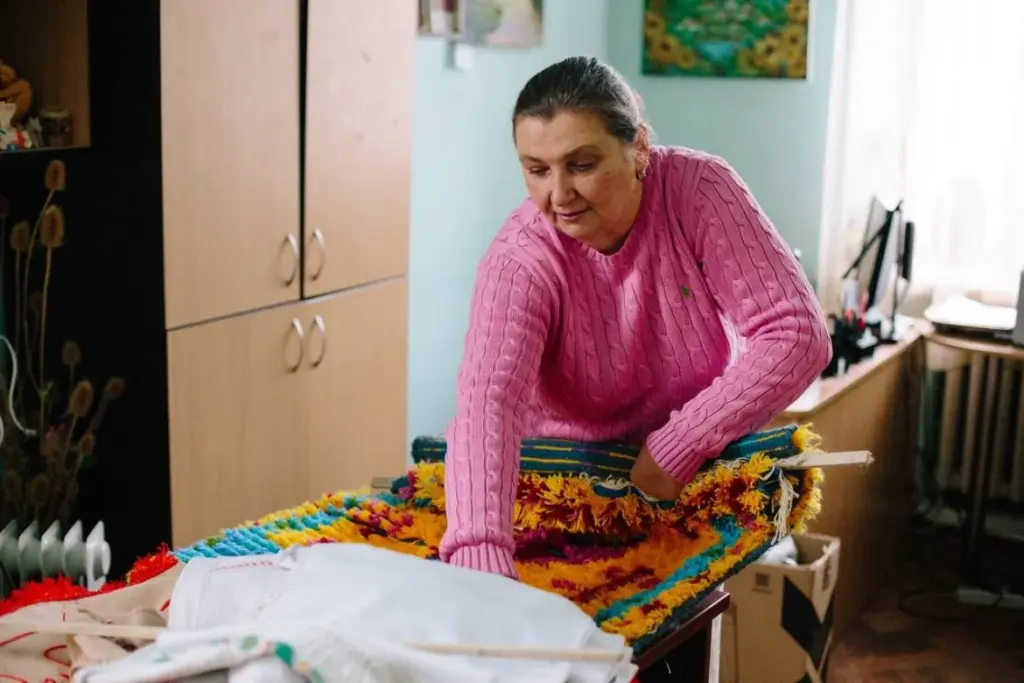
The etymology of the word “razbiei” (or “rozboi”) has not yet been thoroughly studied. So far, we have only found a similar term in Romanian. Its true origin may still require further research.
— And what about the word “kots”? I always thought it was used mainly in Western Ukraine.
— In fact, the word exists in many languages, including German and Czech. In Western Ukraine, it refers not to carpets but to coarse woolen fabric. In the Kharkiv region, however, a kots is a long-pile carpet. Compared to a lizhnyk, for example, the difference is that in a lizhnyk the pile is beaten out, while in our kotsy it is attached in separate tufts or strands.
— What were Kharkiv kotsy used for?
— Their use changed over time. Kotsy were introduced by incoming craftsmen in the 17th century. During frequent military campaigns, they were first used as horse blankets and as coverings in sleds. Later, their insulating properties made them useful in homes.
The Kharkiv Historical Museum holds three very different kotsy. One of them is a horse blanket. It differs from the others in that not all of its surface is covered with pile. The pattern is created not only through color but also through relief arrangement of the pile — likely to make it lighter for the horse.
Another kots has a very long, almost unspun pile—about 15 centimeters. It is the largest one and was used in sleds during winter. People would wrap themselves in it and stay very warm.
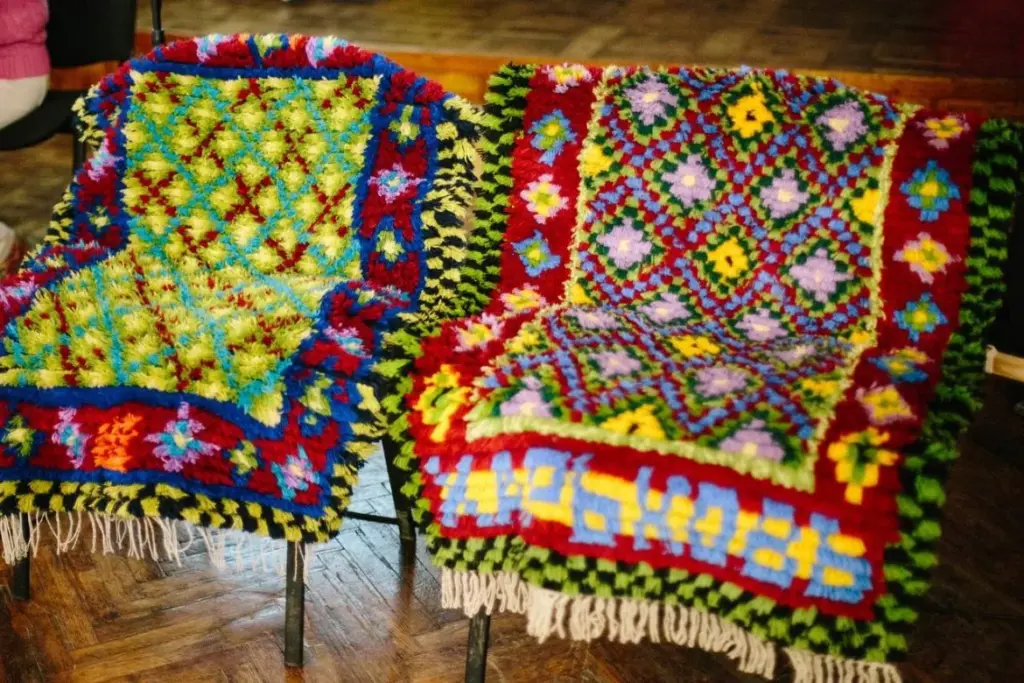
When the need for military use faded, kotsy moved into domestic life. They were used to cover benches, beds, or hung on walls near sleeping areas. My great-grandmother called such a piece a “bedside kots.” The third example, a multicolored one, clearly belongs to domestic use and dates to the 19th century. Its pile is shorter—about 3–4 centimeters—and it is medium-sized.
Unfortunately, the exact regions these kotsy came from are unknown, as their documentation was lost during World War II. What we do know is that two of them were part of the collection of the H. Skovoroda Museum of Sloboda Ukraine, which operated in the early 20th century.
— In Kharkiv, there is a Kotsarska Street stretching from the Annunciation Cathedral to the railway square. Is it related to kotsy weavers?
— According to local legend, the name comes from migrant kotsy weavers who settled beyond the city ramparts in the Zalopanska settlement. This name helped us identify the work of some 20th-century artisans as part of the kotsy weaving tradition, which had once been a recognized craft. By then, almost no one used the word “kots” anymore—they were mostly called “shaggy bedside rugs.”
However, according to research by Kharkiv local historian Andrii Paramonov, the street officially received its name in 1804 from provincial surveyor Mykola Drahomyr, who was mapping the city.
— Do we know anything about the Kharkiv kotsy weavers themselves?
— There is evidence that by the early 18th century, Kharkiv kotsy weavers had achieved such a high level of skill that they became known in Saint Petersburg. In 1740, someone presented two horse blankets there. Their beauty and practicality caught the attention of the imperial stables, which then ordered 500 pieces. The correspondence lasted nearly ten years. Kharkiv weavers responded to each inquiry, but history preserved the names of only fifteen who agreed in 1747:
- Kost Kocherha,
- Harasko Skolozdriia,
- Matvii Lytvynenko,
- Semen Kravets,
- Semen Kocherzhenko,
- Ivan Domashenko,
- Oryna Poddubna,
- Ahafia Korniikha,
- Hanna Kotelevska,
- Palazhka Kotelevska,
- Melaniia Lapchykha,
- Mariia Kuriazkivna,
- Feodosiia Plakhotnykova,
- Praskovia Polskovna,
- Mariia Bezystychnia.
Unfortunately, we know nothing about the others. I would really like to see a commemorative plaque on Kotsarska Street dedicated to these fifteen.
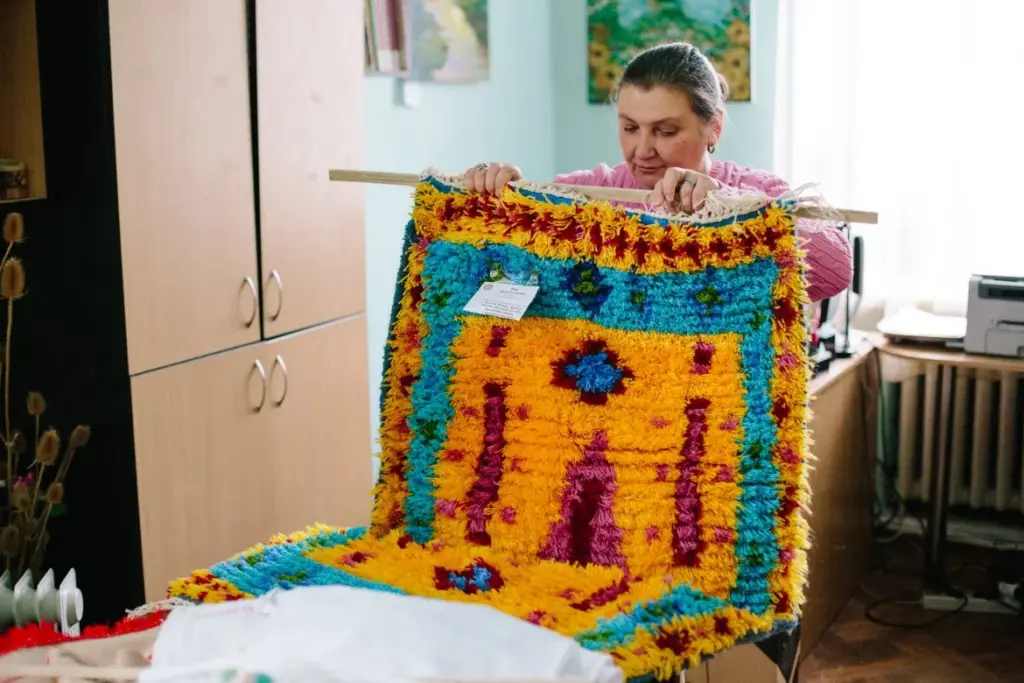
There is also information about the last traditional professional kotsy weaver, found on Kholodna Hora by ethnographer Vasyl Babenko. She wove several sample pieces for him, but we still do not know her name.
And then there is my great-grandmother. I learned about her skills by chance, and we still don’t know where or from whom she learned.
There is also another hereditary kotsy weaver in Kharkiv—Viktoriia Petrivna Ripko. Her grandmother also wove kotsy. Viktoriia herself knows how to do it but does not practice.
So each case remains something of an unsolved mystery.
— What about ornaments? Do they have symbolic meanings?
— There are no mythological meanings behind them. The kotsy from the museum collections feature purely geometric, diamond-shaped patterns. The only distinctive element is a monogram-like figure in the center of the horse blanket. Babenko also described geometric patterns but mentioned circles and semicircles as well.
In the 1920s, Kharkiv had a Museum of Ukrainian Art directed by the well-known researcher of Sloboda Ukraine, Stefan Taranushenko. During expeditions to Okhtyrka and Zinkiv, his team discovered four kotsy with interesting plant-geometric ornamentation. He described two of them, along with the horse blanket from the Kharkiv Historical Museum, in his article “Kotsy of Kharkiv Museums.”
Interestingly, when I studied the horse blanket in 2018 together with museum researchers, we concluded that the central monogram depicts a lion’s head. However, a few years later, I read that Taranushenko interpreted it as a bouquet.
— You mentioned that your great-grandmother also wove kotsy. Does that make you a hereditary kotsy weaver as well?
— It seems so (smiles). Although I learned by chance. Since childhood, I’ve practiced various forms of decorative art. While studying at the Faculty of Art and Graphics at H. Skovoroda Kharkiv Pedagogical Institute, I was weaving a course project on a frame loom. My grandmother walked by and said that her mother—my great-grandmother—used to do the same, but on a large frame leaning against a wall. She immediately showed me what was done differently.
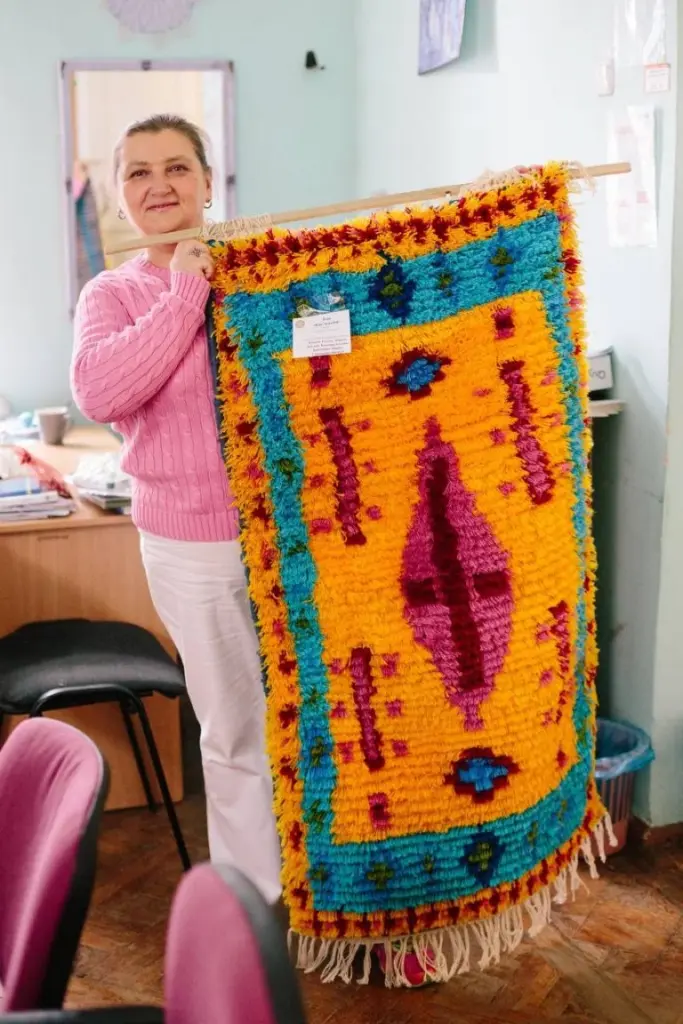
I became gradually interested and started weaving small kotsy as gifts. When I realized how few people were practicing this craft, I understood that this was my path.
— What is the state of kotsy weaving in the Kharkiv region today?
— We are slowly reviving it. At the moment, kotsy weaving is practiced in Kharkiv, Valky, and Koviagy. In the latter two, the Valky School of Arts and its branch operate, where my student, teacher Olena Koval, teaches kotsy weaving. Together, we developed a program called “Kotsy Weaving (elective course),” which we tested with two classes. Since 2022, a revised version has been recommended for use in art schools across the Kharkiv region.
— Can anyone learn to make kotsy? What does it take?
— On September 9, we launched “Kotsy Weaving Studios” at the Kharkiv Regional Organizational and Methodological Center for Culture and Arts on Pushkinska Street, 62. We teach the craft there. And, pleasantly, there is a lot of interest—people are genuinely curious.
The first group has already been formed and will begin practice on September 23. Initial training takes four weeks. After that, students continue independently, and we start working with the next group. So if someone didn’t make it into the first group, they can sign up for October or later. After all, “the skill of weaving a kots is something you carry with you. Wherever you go, it stays with you—just like Kharkiv itself.”
Author: Tetiana Khoronzhuk