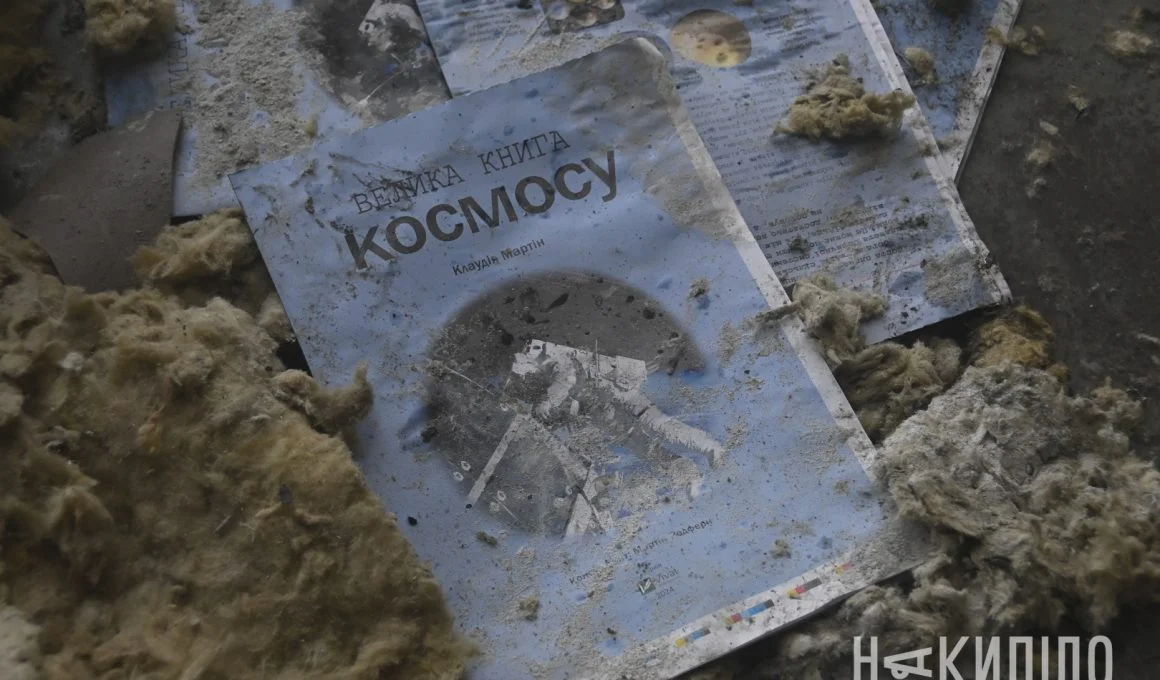
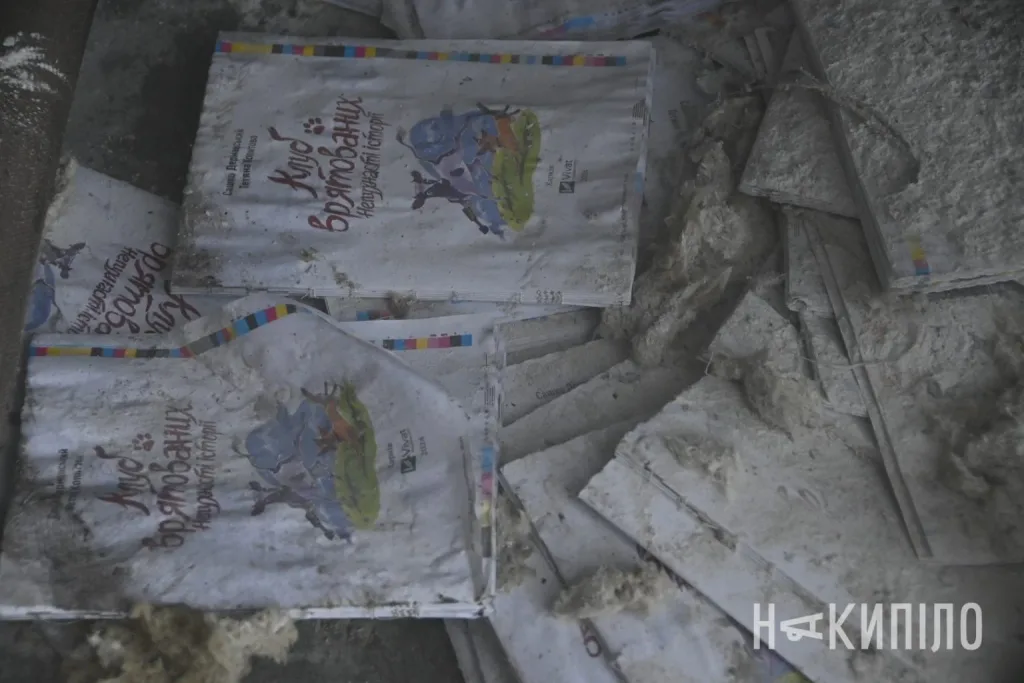
On May 23, 2024, Russian invaders launched missiles at the Kharkiv printing house Faktor-Druk. This is one of the largest full-cycle printing complexes in Europe. Books from nearly all Ukrainian publishing houses were printed there. As a result of the attack, seven people were killed and twenty-one were injured. Nearly 50,000 books were destroyed in the fire.
Such a barbaric attack on books, printing houses, libraries, and cultural heritage in general is far from the first. Throughout its history, the russian state has destroyed vast amounts of knowledge. As a result, future generations have been deprived of valuable information about the past—both russia’s own and that of the peoples it conquered. Book burning, in general, is a history of hatred, ignorance, prejudice, expansion, and replacement. Read more about this form of cultural genocide in our article.
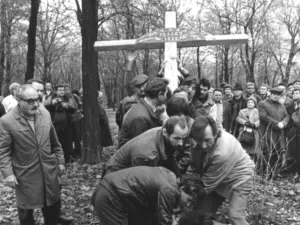
The value of information, experience, accumulated knowledge, and the memory of generations is beyond question. For this reason, states and ruling elites throughout history have sought to control them. On the one hand, knowledge was recorded in writing, collected, and passed on to descendants. At the same time, many rulers sought to suppress knowledge. They destroyed books, archives, and libraries. They also often persecuted or killed those who wrote, preserved, or shared information.
Libraries, bookstores, and archives are critically important to the life of societies and states. They organize and preserve knowledge. Since ancient times, people have created and collected clay tablets, papyri, parchment scrolls, manuscripts, books, magazines, newspapers, photographs, and other documentary traces of civilization. These collections contain vital details of everyday life—agriculture, industry, trade, finance—while also serving as repositories of ideas, plans, discoveries, dreams, and the cultural achievements of nations.
The significance of bookstores and archives is understood both by those who wish to protect knowledge and by those who seek to destroy it. As George Orwell aptly observed: “Who controls the past controls the future: who controls the present controls the past.” Open access to information often contradicts the goals of many governments. Therefore, books as carriers of information have been secretly and ceremonially burned, destroyed, and drowned. The purpose of public book burning has always been the same: the destruction of culture.
There is even a special term for this phenomenon: biblioclasm (from the Greek βιβλίον — book, and the English biblioclast — one who destroys or damages books). The term describes the intentional destruction of books and libraries, usually by burning, by individuals, armed groups, religious extremists, militant atheists, political radicals, and both state and non-state organizations.
To describe such deliberate destruction of books, British literary scholar and Director of the Bodleian Library in Oxford, Richard Ovenden, uses the word “bookicide.” The library is named after Sir Thomas Bodley, a collector of ancient manuscripts. Though its founder is considered to be Bishop Thomas de Cobham (who lived in the 14th century). He established a collection of books at the University of Oxford. The books were chained to the shelves to prevent them from being taken outside the building. Interestingly, even today, users of the Bodleian Library swear an oath “not to bring into the library, or kindle therein, any fire.”

Wikipedia
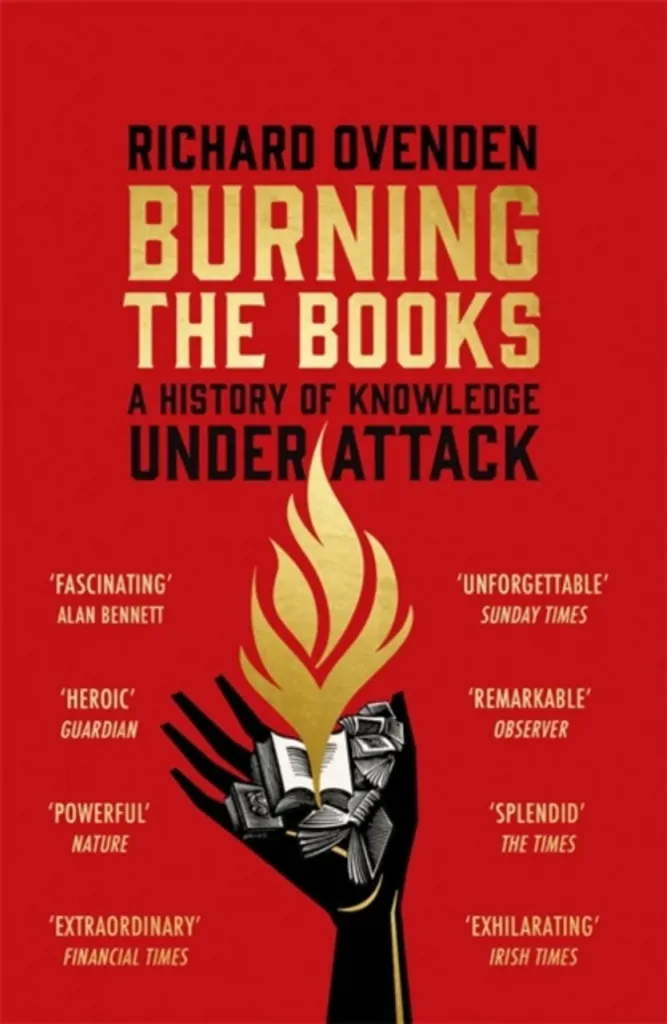
In his book Burning the Books: A History of Knowledge Under Attack, Richard Ovenden identifies the primary motive of biblioclasts: the perception of books as a threat to existing authority, the dominant religion, or ruling classes. Another motive is the subjugation of enemies, the moral humiliation of the defeated or political opponents, and the deprivation of their historical memory and ideological foundations.
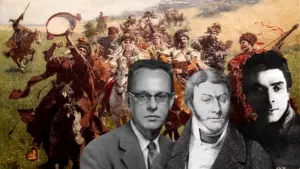
The term “cultural genocide” was proposed by scholar Raphael Lemkin. It refers to acts of systematic destruction of traditions, values, language, and other elements that distinguish one group of people from another. Lemkin identified two phases of cultural genocide: the destruction of the pattern of the oppressed group and the imposition of the oppressor’s pattern.
In addition to the destruction of national heritage sites, cultural monuments, artistic and literary works, cultural genocide also involves the destruction of creative individuals, artistic collectives, museum workers, musicians, actors, clergy, and employees of educational institutions.
This is precisely what we are witnessing today: one of the principal objectives of russian aggression against Ukraine is the cultural genocide of our people. The destruction of knowledge, the erasure of national memory and its bearers, is part of the war’s purpose. russians seek to impose their own version of history and replace Ukrainian national culture with russian culture.
Thousands of cases of biblioclasm have been recorded throughout human history. Beginning with the Hittite Kingdom, Nineveh, and Assyria, there have always been those who preserved knowledge and those who tried to prevent it. The earliest known instances of the destruction of books and libraries occurred in the ancient Greek city of Thebes (1358 BCE) and in the book collection of Pharaoh Amenhotep IV Akhenaten in 1336 BCE.
Some of the earliest known book burnings occurred in Ancient China. The Burning of Books and Burying of Scholars is a famous event in Chinese historiography. In 221 BCE, Emperor Qin Shi Huang ordered scholars to be buried alive and their books burned. The idea behind the book burning was to proclaim the establishment of a new legal order.
The emperor was convinced that the ideas contained in books threatened his vision of a new social order—a “universal Chinese state.” According to this doctrine, in the realm of a wise ruler there should be no books and no writings on bamboo slips; the law alone should serve as doctrine. There should be no speeches of former rulers; contemporary statesmen alone should be models for imitation. Interestingly, the destruction did not extend to books on agriculture and horticulture, medicine, pharmacology, or divination.
As a result of wars and the actions of fanatics, the famous Library of Alexandria burned repeatedly. Nearly 700,000 handwritten books, collected over more than seven centuries by the rulers of Egypt, were destroyed in the flames.
Europe, too, witnessed mass and regular book burnings. In 814, the library of Charlemagne, King of the Franks and Emperor, was burned. In 867, the library of Patriarch Photius suffered the same fate.
The institution most infamous for book burning was the Holy Inquisition. Beginning in the 13th century, the practice of auto-da-fé—burning books together with their authors or owners—was officially employed in Western Europe. The first known auto-da-fé involving the destruction of books took place in the French city of Montpellier in 1233.
Thereafter, for six centuries, auto-da-fé became commonplace in the Catholic states of Europe and Latin America. Thus, in 1499, in Granada, Spain, the cardinal inquisitor ordered the burning of all manuscripts except medical ones.
In Florence, from 1494 to 1498, at the height of the Renaissance, the so-called “Bonfire of the Vanities” was practiced by order of the dictator Savonarola. Savonarola organized a group of boys who burst into the homes of noble families, ostensibly to ensure compliance with the Ten Commandments. These medieval vigilantes roamed the city confiscating playing cards, flutes, perfumes—and secular books. All of it was then ceremonially burned.
In 1529, Spanish conquistadors destroyed all Aztec codices in Mexico. Codices were various manuscripts created by the Aztecs. Every temple possessed a library of religious and astrological manuscript codices. Historical chronicles, genealogies, family lineages of rulers and nobles, maps of borders, boundary markers of cities, provinces, and villages, land registers, law books, descriptions of rituals and ceremonies, celebrations in honor of the gods, calendars—an immense body of knowledge concerning the history and culture of the indigenous peoples of Central America was lost forever.
The last victim executed by the Spanish Inquisition was put to death in Valencia in 1826. He was a schoolteacher, Cayetano Ripoll, accused of heresy and unwilling to recant.
In russia, although there was no Inquisition, books were burned frequently and for centuries. The Kormchaya Kniga (“Pilot Book”), which regulated church life, contained the following provision: “If anyone keeps heretical writings and believes in their sorcery, he shall be cursed together with all heretics, and those books shall be burned upon his head.”
A vast number of Old Rus’ manuscripts were destroyed during the Mongol invasion. The campaigns of Ivan III against Novgorod and the struggle against the Old Believers were also accompanied by book burnings. The legendary library of Ivan the Terrible, containing countless treasures, vanished without a trace into the depths of history. During the Moscow fire of 1812, many unique collections perished, including the library of A. I. Musin-Pushkin, which contained the original manuscript of The Tale of Igor’s Campaign.
Biblioclasm manifested itself repeatedly on Ukrainian lands as well. The library of Yaroslav the Wise was destroyed during the Mongol conquest of Kyiv in 1240. Later, Muscovite church hierarchs attempted to eradicate local books. In 1688, Patriarch Joachim of Moscow ordered that the collection of sermons The Crown of Christ by A. Radyvylovskyi, deputy superior of the Kyiv Pechersk Lavra, written in the Ukrainian language, be removed from all libraries and monasteries and publicly burned. The works of prominent Ukrainian theologians Petro Mohyla, Lazar Baranovych, and Innokentii Gizel were also burned.
In 1702, during the burning of Baturyn by Menshikov on the orders of Peter I, the extensive library of Hetman Ivan Mazepa was destroyed. In 1718, monks from Muscovy set fire to the unique and extensive library of the Kyiv Pechersk Lavra together with its archive, which contained documents relating to Ukraine’s historical past. Under the rule of Catherine II, in 1780, the library of the Kyiv-Mohyla Academy at the Brotherhood Monastery burned down completely. Collected over more than 150 years, it had been one of the richest libraries of its time.
In Germany during the 1930s, the National Socialists came to power and revived the medieval practice of book burning. Mass book burnings became a turning point in Nazi ideological policy. Biblioclasm spread even among educated people, professors, and students.
Student organizations announced that on the evening of May 10, books “alien to the Aryan spirit” would be burned in public squares across the country. University lecturers and members of the local intelligentsia were strongly encouraged to attend. Students at the Munich Technical University distributed “Invitations to the Burning,” complete with a script for the event. The dress code was specified: uniform or black suit.
On May 10, 1933, seventy thousand people gathered in the square in front of the State Opera building in Berlin. The Nazis staged a “Festival of Fire”—a public burning of books that contradicted the “Aryan spirit.” Herbert Gutjahr, leader of the student movement, delivered a contemptuous speech: “We have acted against the un-German spirit. I cast everything un-German into the fire,” he shouted.
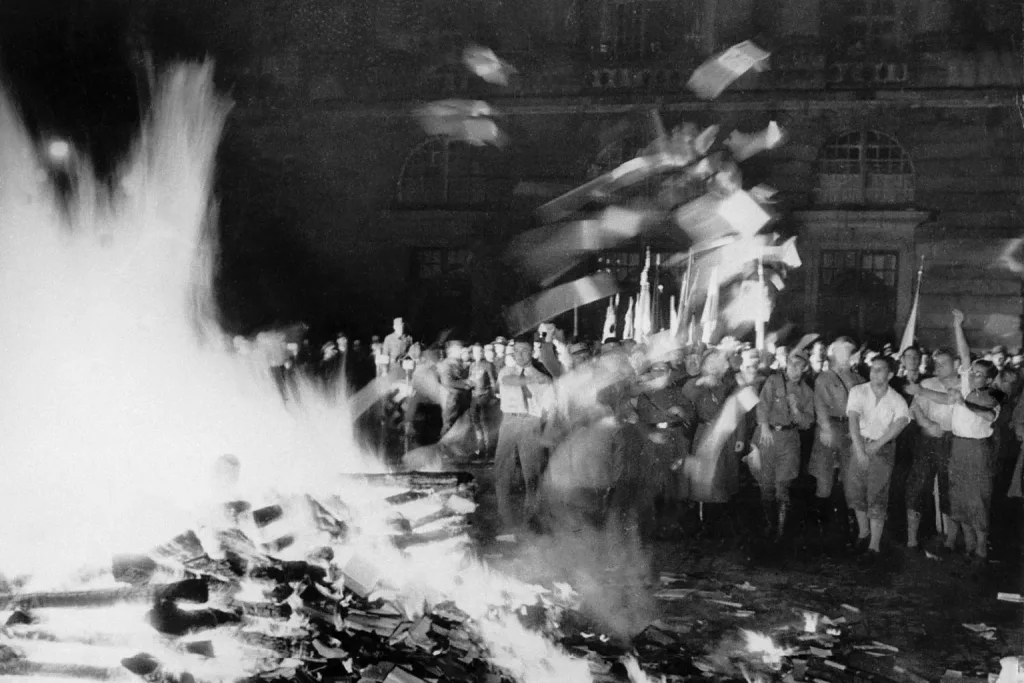
Getty Images
The book burning at Opernplatz was broadcast live and transmitted on the radio. Many students and some professors arrived wearing SS uniforms. It was the student body itself that brought thousands of books representing the “un-Aryan spirit” to the city square.
Among the authors whose books were burned were Walter Benjamin, Albert Einstein, Friedrich Engels, Lion Feuchtwanger, Sigmund Freud, Jaroslav Hašek, Franz Kafka, Theodor Lessing, Ludwig Marcuse, Karl Marx, Heinrich and Thomas Mann, Erich Maria Remarque, Anna Seghers, and Arnold Zweig.
Not only German books burned. French, American, Russian, English, and Irish works were thrown into the flames as well. Among their authors were Henri Barbusse, Victor Hugo, and Romain Rolland; Theodore Dreiser, F. Scott Fitzgerald, Ernest Hemingway, and Jack London; Joseph Conrad, Aldous Huxley, and H. G. Wells; James Joyce and Oscar Wilde.
Berliners calmly and cheerfully watched, accompanied by grand military marches, as the creative energy, glory, and talents of their country and of world literature burned before their eyes. Some authors personally witnessed their books being consumed by the flames.
Erich Maria Remarque was among those deeply shocked and saddened. Having fought in the First World War, he portrayed war in All Quiet on the Western Front as a monumental catastrophe. The Nazis did not forgive Germany’s most famous anti-war novel, and it was cast into the fire. The author was accused of undermining military morale, discrediting German soldiers, and literary treason.
Similar scenes unfolded throughout Germany. The grandiose ceremonies included torchlight processions, music, singing, “fire oaths,” and ritualistic incantations. In university towns across the country, students burned the books of authors who did not conform to Nazi ideology. For an auto-da-fé, it was enough for an author to be a pacifist, socialist, sexologist, Frenchman, or Jew.
The Nazis compiled “white lists” of books intended to replace the confiscated ones. Approved reading included Goethe and Schiller, romance novels, and war literature glorifying brotherhood and devotion to Germany.
For many writers, Nazi persecution ended in death. Some died in concentration camps, some were executed, others took their own lives, and many were forced into exile.
Book burning became a symbol of the final establishment of the Nazi dictatorship in Germany. In the Western press, the book burnings of May 10, 1933, were called the “Book Holocaust.” Journalists quoted the 19th-century German poet Heinrich Heine: “Where they burn books, they will ultimately burn people as well.” His words proved prophetic. The persecution of artists quickly evolved into a hunt for all those who opposed the regime and ultimately led to the mass genocide of human beings.
During the Second World War, the Nazis demonstratively burned books in occupied territories. In Poland, for example, they destroyed 80% of school and academic libraries. In Belarus, 83% of all book collections were lost.
Many libraries in Ukraine were also burned. The largest destruction occurred on November 5, 1943. As they retreated from Kyiv, the Germans set fire to the regional library (today the Yaroslav the Wise National Library of Ukraine). Nearly one million books perished in the flames.
In territories occupied by Romania, Germany’s ally, books and even gramophone records in all languages except Romanian were destroyed. In Chișinău, 1.2 million volumes were burned; in Tiraspol, 250,000. Books were also burned in the southern regions of Ukraine, where a policy of “Romanianization” was being implemented.
Chinese communists and Red Guards burned unique monastic book collections in Tibet between 1966 and 1976, later turning on their own libraries as well. This took place during the so-called Cultural Revolution.
In 1992, Serbian soldiers set fire to the National Library of Bosnia and Herzegovina in Sarajevo and killed firefighters who attempted to extinguish the blaze.
A large number of library books were burned by the Afghan Taliban.
A sea of flames fed by thousands of books in the squares of medieval Europe differs little from the bonfires of Nazi Germany or those on Ukrainian territory attacked by russia. Many masterpieces and priceless historical monuments of the past have been lost to humanity and to historical memory. Today, putin’s regime is acting in the same way.
Following the annexation of Crimea, inspections were conducted in local schools to identify and destroy prohibited books. The list of banned literature included 2,442 titles, among them books, articles, leaflets, and even song lyrics. Representatives of the so-called “russian world” publicly burned books on the history of Ukraine and Ukrainian school textbooks in Crimea in January 2014, and later in Kharkiv on March 16, 2014.
Since the beginning of the full-scale invasion, russians have conducted book-burning campaigns in schools, museums, and libraries throughout the occupied territories of Ukraine. They deliberately destroy art galleries, libraries, archives, and books. In June 2022, russian occupiers confiscated and burned the entire large library of the Petro Mohyla Ukrainian Orthodox Church in Mariupol in the church courtyard. The collection had been assembled by volunteers and benefactors and contained unique Ukrainian-language publications.
Cities that russia failed to occupy have been targeted with missiles. As early as 2022, the russian federation launched a missile strike on the Hurov & K printing house. Later, it struck the Ranok publishing house and damaged Unisoft, one of Ukraine’s largest printing companies. Missile attacks destroyed the museums of Hryhorii Skovoroda, Maria Prymachenko, and Nestor Makhno. The museum of Polina Raiko was lost due to flooding.
According to the Ukrainian Library Association, three national and state libraries, including the National Scientific Medical Library of Ukraine, and twenty-five university libraries have been seriously damaged or destroyed. Among public libraries, forty-seven have been completely destroyed and cannot be restored. Another 158 have suffered severe damage and require major repairs, while 276 have sustained less serious damage. Among the destroyed institutions are several buildings of the V. N. Karazin Kharkiv National University Library. It housed numerous early printed books and manuscripts, as well as important Ukrainian archival collections.
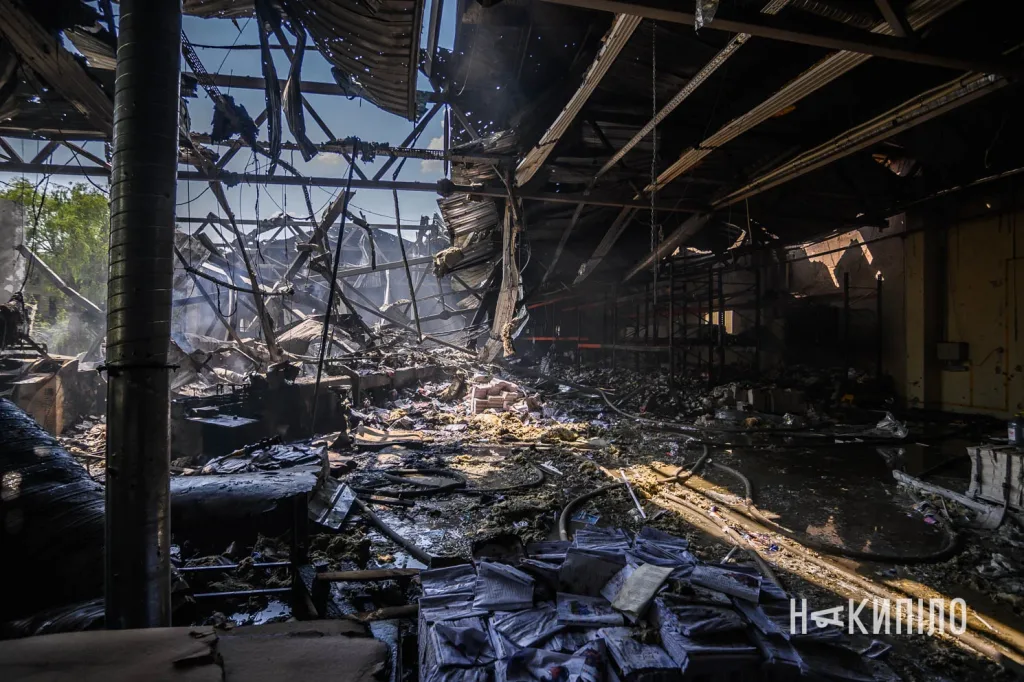
The most devastating blow was struck by Russia on May 23, 2024, in Kharkiv. The occupiers targeted Faktor-Druk, one of the largest full-cycle printing complexes in Europe. Books from the majority of Ukrainian publishing houses were printed there. As a result, the Russian missile attack destroyed the following titles:
- Words and Bullets by Nataliia Korniienko;
- Hunters of Happiness. If We Have to Die, I’ll Wake You Up by Valerii Puzik;
- Motanka — an anthology of short speculative fiction by Ukrainian women writers;
- The Emerald of Princess Nesvytska by Oleksandr Irvanets;
- The Underground State by Andrii Kokotiuha;
- You Can’t Fight and Retreat by Pavlo “Pashtet” Belianskyi;
- All My Keys and Gaia. Fire of the North by Nataliia Matolinets;
- New print runs of Gerard the Partisan by Ivan Andrusiak
- The Rescue Club: Non-Fluffy Stories by Sashko Dermanskyi and Tetiana Kopytova;
- Funny You Should Ask by Elissa Sussman;
- The Marriage Portrait by Maggie O’Farrell;
- Nora Goes Off Script by Annabel Monaghan;
- The Cruel Prince by Holly Black;
- The Overnight Guest by Heather Gudenkauf;
- Iron Widow by Xiran Jay Zhao.
Children’s books were also affected:
- Stories of Fearless Girls;
- Little Ball of Yarn Rushes to the Rescue;
- Huxley and Oladyk Rush to the Rescue;
- The Big Book of Fairies and Princesses;
- One Against All;
- Heroes of Greek Mythology;
- Freya and the Fearless: Into Battle;
- Additional print runs of The Rescue Club by Sashko Dermanskyi, Gerard the Partisan by Ivan Andrusiak, The Big Book of Space, and The Children’s Encyclopedia of Planet Earth.
Thousands of textbooks were destroyed, including German-language textbooks for seventh-grade students published by Ranok.
Like Stalin’s executioners and Hitler’s followers before them, russian nazis today destroy not only books but also the people who create culture. They kill and torture writers, musicians, actors, translators, librarians, artists, sculptors, photographers, archaeologists, and conductors—both men and women. The so-called “russian world” has unleashed a genocide against Ukrainians, open and unapologetic. Just as the Nazis did against Jews and other peoples they considered “non-Aryan.”
The poet and writer Volodymyr Vakulenko was cynically murdered by russian forces during the occupation of Izium. Before his death, however, he managed to bury the manuscript of his diary in his yard beneath a cherry tree. His body was later found among graves in a forest. After the liberation of the Kharkiv region, the diary was recovered by his friend, writer Victoria Amelina. She personally searched for it and later published it. Victoria Amelina herself was killed by russian forces following the shelling of Kramatorsk in 2023.
In Kupiansk District of the Kharkiv region, russian occupation authorities ordered all books published after 1991 for school libraries—including children’s books and fairy tales—to be registered and destroyed. They were replaced with officially sanctioned materials brought from the russian federation.
Ukraine is fighting a brutal war, one that is also a struggle for memory and identity. Yet the russians will not succeed in committing cultural genocide. Even during wartime, new bookstores continue to open across Ukraine. Long queues form outside the Book Arsenal Festival and other literary events. New bookstores open every month, new bestsellers appear, and the country is experiencing a genuine reading boom.
Printing houses, schools, and bookstores can be rebuilt. The people we have lost cannot be brought back. Yet, as Victoria Amelina wrote in the foreword to Volodymyr Vakulenko’s occupation diary: “As long as a writer is being read, they remain alive.”
Hitler’s followers failed to destroy other nations, their creativity, and humanistic literature, no matter how many books they burned. They lost. Modern Germany is ashamed of the book-burning bonfires that once blazed in its public squares, yet it does not forget them. Since 1947, May 10 has been commemorated in Germany as a Day of Remembrance of Public Book Burnings.
The new Nazis—the russians—will lose this battle as well. Richard Ovenden emphasizes that the world must hear the voices and stories of Ukrainian libraries. Behind the statistics stand real people with unique lives and experiences. That is why it is critically important to speak about and tell the world of the crimes committed against Ukrainian libraries, knowledge, documents, and cultural heritage.
All of us bear the imprint of fire.
And at the same time, we are proof that the true Word does not burn.