We talk about social responsibility as the foundation of successful business during wartime. We discuss conscious memorialization and ethical commemoration of fallen defenders through the example of the “Table of Remembrance” initiative, which has gained popularity in Ukraine during the years of russia’s full-scale war.
— “Creating rituals of remembrance helps society make sense of war, unite people around a shared experience, and pass this memory on to future generations.” This is the mission of the NGO Vshanuy (“Honor”), co-founded by Kateryna Datsenko. Today, the team also works with Ukrainian businesses, helping them implement commemorative practices ethically. Kateryna says there is currently strong demand among businesses for dignified and ethical commemoration. However, motivation, thoughtful implementation, and alignment with both companies’ values and their employees’ values are critically important.
Kateryna Datsenko:
In general, we work very closely with the Memorial memory platform. Since it was established much earlier than we were, by 2023 it was already working with businesses. We began working with businesses through the moment of silence, around 2024, when Ira (Iryna “Cheka” Tsybukh, founder of the NGO Vshanuy — Ed.) was still alive. We were more concerned with conveying to businesses why commemoration matters to other people, so that businesses could become a voice for these changes. Businesses tend to adapt to broader social changes. In my view, that is not a bad thing, because when the topic of memory and commemoration — particularly through the moment of silence that we advocated for — became more widespread and more deeply understood, businesses also began thinking about how to implement and structure it.
Today, we see completely different approaches to memory among different businesses. First and foremost, it is closely connected to veterans’ affairs. In many companies, the same people are responsible for both. In other words, there is rarely a dedicated memory specialist. Usually, it is either people responsible for internal processes, such as CSR departments (Corporate Social Responsibility — Ed.), or people overseeing veterans’ initiatives.
What do businesses need today? There is often a demand for consultations, lectures, and explanations about how memory works in general and why it matters. Businesses want to foster a culture of remembrance, but they often ask for professional guidance on why it is truly necessary. There are requests for guidance on how they want to commemorate within their own company, so that it is not generic but reflects their values, interests, and people. Most importantly, every business seeks to personalize the memory of its own people.
Another point that seems quite interesting to me is that businesses are, in my opinion, highly structured organizations. As a result, they seek to bring structure to remembrance as well. If they feel they lack ideas, perspectives, or an understanding of how such a structure should work, they turn, for example, to Memorial, to Mariika Hrabar (initiator of the “Table of Remembrance” campaign — Ed.), or to us, to people who work in this field.
— Are there businesses that have already integrated remembrance into their spaces or operations in a very thoughtful, consistent, and sustainable way? And is this understandable to the people they work with?
Many businesses begin with individual initiatives, such as a moment of silence or a “Table of Remembrance,” or by creating an online memorial. Then they consider whether that is enough or whether they want to build a broader system. For example, for one of the businesses we work with — together with the Memorial memory platform — we conduct a memory audit: what they are already doing, how they communicate, what they want to establish internally, and what their potential future steps might be.
McDonald’s started with a moment of silence and now wants to expand into other commemorative practices. The IT company Intellias also began with a moment of silence, then created a “Wall of Remembrance,” and later requested a lecture. Overall, the company has developed a systematic approach to understanding memory. Aurora likewise started with a moment of silence, has an online memorial, and is currently working to build its own system. Then there is Goodwine — one of the few businesses focused on continuity. It began with “The Wines Vika Loved,” dedicated to its deceased sommelier. This later evolved into a charitable foundation supporting young families. Incidentally, in my opinion, it is one of the few businesses commemorating a civilian rather than a military figure.
— Is this primarily about corporate culture and supporting the team — remembering colleagues who went to defend Ukraine and were killed? Or is it also about communication with customers and people who buy a company’s products or services? Why does a business need to engage in commemoration?
I think that, on the one hand, businesses communicate their values to external audiences in this way. On the other hand, for employees, they demonstrate that these values are not just words but actions. Businesses know their employees. They interact and work with them, especially in small and medium-sized companies. In my view, this is a way to preserve the memory of a person and tell everyone that they were one of us, but chose to go and protect us all.
— At the beginning of our conversation, you said that the original idea was for businesses to become a voice for this message. Has that happened? If we talk about the work of the NGO Vshanuy, what has already been achieved through cooperation with businesses, and what are the future plans?
I think a good example of whether businesses have become such a voice is a recent post by a journalist who photographed a sign at a coffee shop in Khmelnytskyi. The sign stated that the café operates from 08:00 to 08:59 and from 09:01 to 20:00. Between those times, they observe a moment of silence. The post spread widely across social media, with many people sharing and commenting on it. I believe businesses are becoming part of building the broader culture of remembrance that we talk about so often.
What would we like to do through Vshanuy? We definitely want to continue working with businesses. Perhaps helping them establish systems or at least showing them what such systems can look like. In my view, any system is better than isolated and unplanned actions.
—What will this give us as a society, now and in the future?
Perhaps we will finally rediscover ourselves. We will understand who we are, why we are fighting, and what we are fighting for. Most importantly, we will understand how many of our best people we have lost. And perhaps we will realize that none of it was in vain.
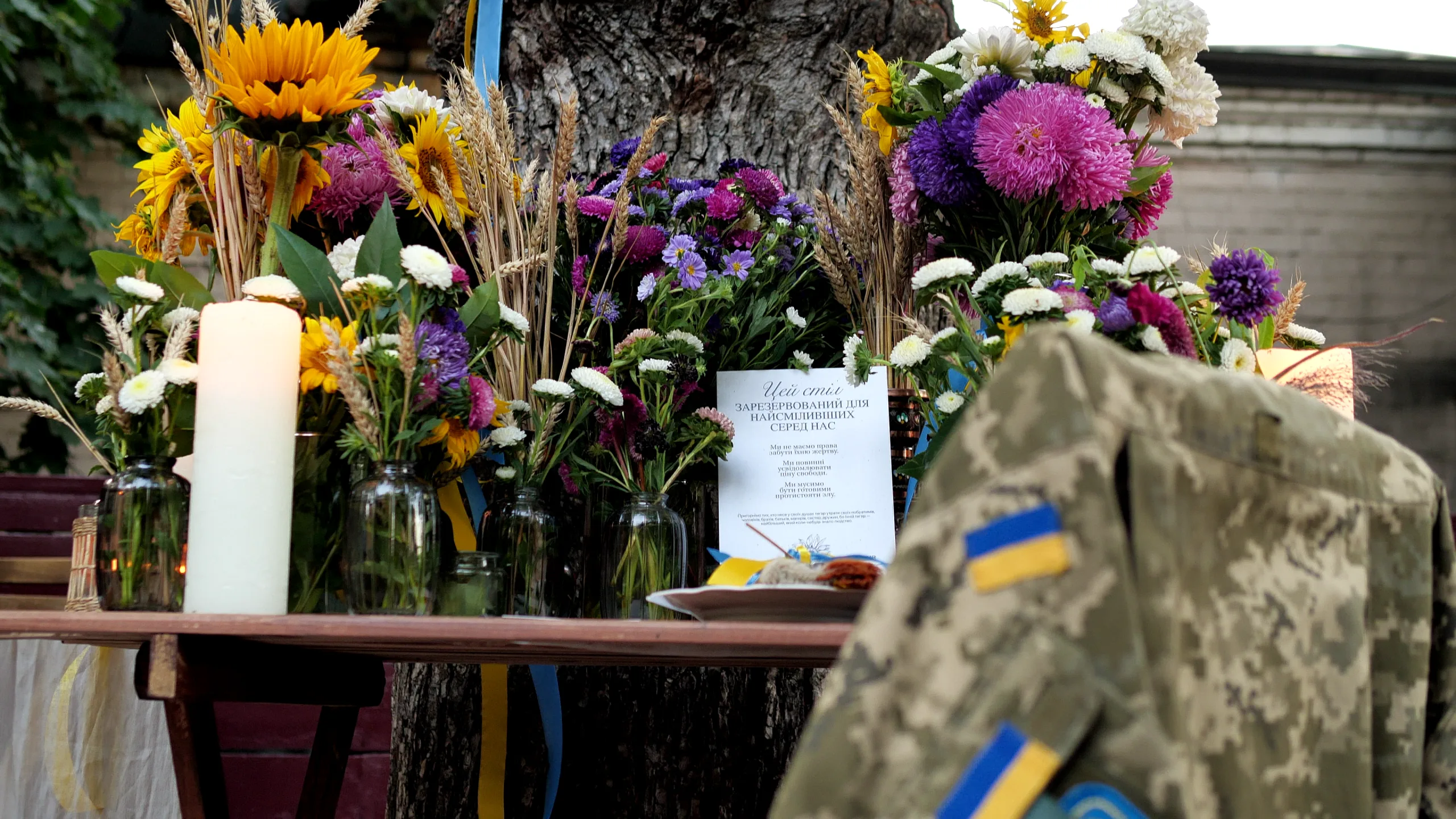
—The “Table of Remembrance” is a Ukrainian initiative dedicated to honoring heroes, inspired by military traditions in the United States. There, on Memorial Day, people set tables in restaurants and homes to remember those who were killed. Three years ago, Mariia Hrabar developed a similar initiative in Ukraine. Now, every year on August 29, the Day of Remembrance of the Defenders of Ukraine, tables in Ukrainian restaurants, bookstores, schools, and hospitals are reserved in memory of fallen warriors. Mariia lost her husband, Illia, a musician and serviceman. He was killed near Bakhmut in December 2022. Afterward, Mariia established the Illia Hrabar Charitable Foundation and launched the nationwide “Table of Remembrance” campaign. How and why did this initiative grow to such a scale? What does ethical commemoration mean, and how can one implement or create a practice that resonates with people? We explored these questions further in a conversation with Mariia. The campaign was originally conceived as reserving tables in cafés and restaurants, but educational institutions and bookstores later began joining as well, so it has definitely expanded. What kind of feedback have you observed over these three years?
Businesses have always been open, but their motivations vary greatly. From the beginning, I focused primarily on small and medium-sized businesses. The restaurant industry is deeply involved in social processes and has always responded positively. However, I believe it is ultimately a question of motivation.
Many businesses become involved because of the civic position of their owners or employees. At the same time, many businesses — particularly smaller ones — do not fully understand that engagement in social responsibility and public life is the very foundation of how business should operate in our country during wartime.
This is something I have always wanted to communicate. It changes the framework of interaction between businesses and communities. Communities do not come to businesses simply to ask for help. Instead, they exchange experience and support one another. Businesses also benefit from engaging with communities and participating in solving social problems, including by taking on a role in conscious memorialization.
— Do you see a difference between how businesses implement the initiative and how institutions in other sectors do so? How do you manage to bring together such different types of organizations within such an emotionally sensitive campaign?
The approaches differ. If we are talking about state and municipal institutions, they already have established ceremonial practices, which they naturally adapt to our campaign. Businesses are sometimes more creative. When you start with a blank sheet of paper, you do not have stereotypes, so people often design the tables more creatively.
Our practice is universal. It can be adapted in many different ways. We have never restricted creativity. The main thing is that it is done with dignity and respect. That is the foundation.
I was interested in businesses primarily because they provide spaces visited by many people, allowing commemoration to enter public life. Municipal institutions joined because they already had both the need and the experience to engage in such processes and campaigns. It happened organically.
Among the more interesting business sectors are medical institutions, which expressed a desire to create remembrance tables in their cafeterias, and the Novus supermarket chain, which placed a remembrance table in the middle of a sales floor.
— In other words, they want to commemorate. They want to do something that connects them to their country and society, but they need ethical practices. Have there been negative reactions to the “Table of Remembrance” campaign?
I try to pay attention to negative aspects, but most of them have involved businesses rather than public reactions. Over the course of three years, I tested different approaches.
During the first year, when I organized the campaign myself, I actively advocated for it. I approached businesses and asked them to participate. Since there was little awareness of the initiative at the time, there was naturally a certain percentage of refusals. Sometimes I took it personally. Now I approach it more philosophically.
The following year, when discussing the campaign with colleagues from Memorial, I concluded that businesses should come to us on their own and submit participation applications themselves. We did not ask anyone to join. This is an important detail when discussing the role of social responsibility in business. When businesses come voluntarily, the dynamic is completely different. Their level of engagement is much higher.
There is also a category of people who simply do not understand why remembrance matters today. It is a very small percentage, but it always exists. These are the people who say things like, “You should care more about the living than the dead.” There will always be criticism. Given how complex this campaign is to implement, receiving less than five percent negative feedback is actually a very good result.
— What kind of ethics do you think are appropriate today in remembrance and commemorative practices? So we acknowledge all the difficult experiences while avoiding retraumatization or devaluing anyone’s experience?
If there is a need to commemorate and a desire to do so, then it is worth doing in any case, at least trying. I spent a lot of time reflecting on how the idea for the campaign emerged and how I wanted to implement it. At the time, it was certainly quite unconventional. Predicting whether people would consider it ethical or unethical was difficult because ethics often depend on perspective and on who is carrying out the initiative.
I am always in favor of people developing their ideas, describing them, and putting them into words. Once you have done that, you can approach people you consider experts or opinion leaders and ask for advice. This is especially important for state-level or nationwide initiatives.
When it comes to local commemorative initiatives, I believe people should simply act. If you act based on respect for all participants, your initiative will succeed. If you genuinely want to engage in dialogue, listen, and make adjustments, then I do not think mistakes will be critical. It is far worse to be unseen, unnoticed, and forgotten.
— Is motivation important here? Does it matter whether society understands your intentions and why you are doing it?
Motivation is important. I think it played a major role in my own understanding of the issue.
Whenever someone organizes a commemorative initiative, it is crucial to consider the people for whom the loss is personal. They have the right to any reaction, and you must take that reaction into account, even if it seems illogical.
In my case, I was part of the target audience myself. In a way, that gave me a kind of license. I wanted remembrance tables to exist. If someone asked, “Who needs this?” I could answer, “I do,” because I was the target audience. My personal experience supported me. Of course, from a human perspective, I would have been much happier not to have had that experience. But since I did, it gave me confidence that I was doing the right thing and helped me respond to feedback and adjust the initiative.
If someone wants to join an existing initiative, the ethical and thoughtful framework has usually already been developed. People can simply participate while taking into account certain nuances when implementing a moment of silence or creating a remembrance table. Organizers generally discuss such considerations.
Ultimately, I think this comes down to universal human values: being polite, compassionate, and attentive to people who may be hurt by a particular expression or action. I always say that people should be accurate, truthful, and sincere in what they do. That is usually enough.
— When I first started recording this podcast, I had to explain why remembrance mattered and how it was practiced. Now, however, we are discussing how we do it and sharing experiences with people who want to either implement such practices or join existing ones. We no longer need to explain why remembrance is necessary. And that is already a major step forward.
We live in a certain bubble where everyone understands these things. We need to remember that when speaking with people who genuinely want to engage but live in a different bubble. Their motivation can disappear at any stage, first of all because of fear and uncertainty about how others will react.
This is where the tension lies: the desire to do everything perfectly, ethically, and correctly, while dealing with an extremely sensitive topic. Death and loss have become part of our lives. I can continue living and functioning because death is very real to me. It is part of my life and cannot be avoided. It exists alongside me. At this stage of my life, I can accept that calmly.
At the same time, we must understand that this remains a very sensitive subject. When we discuss the ethics of commemoration, many people do not even want to consider that it is both necessary and not particularly difficult.
What matters most to me is motivating people and businesses to act. It is important to discuss all the possible mistakes, but it is even more important to inspire action. Sometimes, when you focus too much on everything that could go wrong, you take away people’s motivation to engage at all.
Businesses also exist within their own bubbles, and waves of negativity arise from time to time. It is important to understand that sometimes you have to work within those bubbles with people who react very negatively to such initiatives. That is why motivation, consistency, communication, and explanation are so important. You need to find the right arguments and understand that this is ongoing work. You cannot force anyone to do anything. You can only lead by example.
— All of this is based on a personal desire to change something. To speak openly about the need for remembrance, dignified commemoration, and conscious memorialization.
I would like to witness a time when remembrance and commemorative practices become widespread throughout our society. When discussions about ethical and unethical commemoration become mainstream. It seems to me that, right now, we need to discuss commemorative practices in general — their importance and their role in shaping us as a society.
I would like there to be so many of these practices that we would have enough experience and data to analyze them and, through trial and error, find a balanced approach.
For me, the question today is remembrance itself. I believe we are fighting for the very existence of this phenomenon. We explain why it matters. I would like this to become universally understood. Then we would be able to choose among a wide variety of commemorative practices and focus only on questions of ethics — discussing which of them are truly exemplary.
— In your opinion, will this diversity of practices and society’s psychological readiness for them help us begin processing the collective trauma we are experiencing? So much has happened already that many people are becoming emotionally numb. Can commemorative practices help us process, accept, and live through all of this so that we can move forward?
There are two ways of dealing with grief. The first is denial, and the second is acceptance.
By accepting grief through commemorative practices, we make it part of our lives. For me, memory is a moral compass. It helps me remember what happened to me as a person and to my husband as a defender. It is a value-based guide that helps me continue living a dignified life, both as part of society and in my personal life.
This is important to me, and I believe it is important for society as well. On the one hand, there are many commemorative practices. On the other hand, there are also many people who have experienced loss. Everyone has the right to their own practice of remembrance, even a very small one.
That is why it is important to me that there are many such practices and that people engage not only with national initiatives but also with local ones. I believe that if people have lived in a building for twenty years, they should know who lived there before them. Many defenders lived in these buildings and gave their lives. It matters to know that two men who lived in your building sacrificed their lives for your well-being.
I believe everything begins with local initiatives. Commemoration at the level of a residential building is already a commemorative practice. The same applies to streets, neighborhoods, and districts. If a local café or local store talks about this, it performs an important supportive function.
Memorialization is not only necessary but also beneficial. It gives a great deal back to communities, to everyone involved, and to businesses as well. Once you begin engaging in it, that understanding comes naturally.