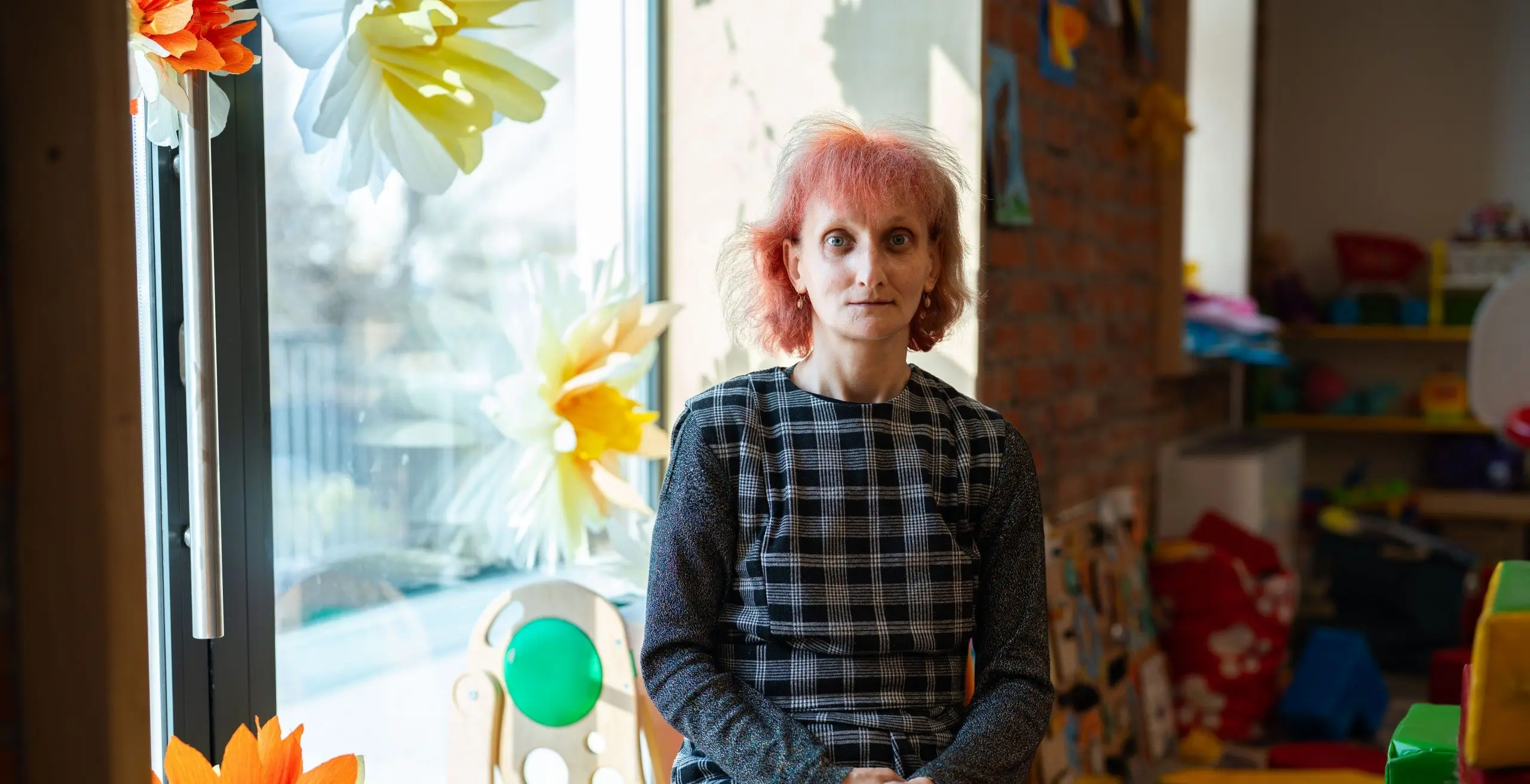
Oksana Rubel lived in the Kherson region with her husband Serhii and their five-year-old daughter Bohdana, who has a disability. When the full-scale invasion began, their village fell under occupation. Despite health problems and constant pressure, the family refused to cooperate with the enemy. Because of his principled stance, Serhii lost his job, while Oksana was denied medical care without a Russian passport.
The occupiers repeatedly broke into their home to conduct searches. Eventually, the family managed to evacuate to Kyiv. Oksana spoke about their new life on the podcast She. War on Nakypilo Radio.
— Please tell us what your life was like before the full-scale war. What were you doing back then?
We lived under occupation for a year and eight months. Even before the full-scale war started, we had bought a house. I had a child, my husband was working. We had a household, we had everything. And then, suddenly, the Great War began. In a single day, everything disappeared. We lost it all.
It was incredibly hard. They started putting heavy pressure on us, carrying out constant searches. There could be three or four in a single week. They came at night and in broad daylight — doors didn’t stop them. I asked what they were looking for. They said maybe we were hiding people serving in the Armed Forces of Ukraine. Later they started forcing us to get Russian passports and a Russian birth certificate for our child. My husband and I refused until the very end — and we never did it.
The last time they stormed into our house and pinned me against the wall, I had a stroke that very evening. I spent the night at home because we couldn’t get to a hospital. In the morning, my husband took me there. I stayed in the hospital for two weeks. When I came home, I said: “Pack our things. We’re leaving.”
Someone had told them that my brother serves in the Armed Forces of Ukraine. I was warned that if I didn’t leave, they would come for me, my husband, and our child. I was terrified. Of course, I was also afraid to leave.
— Was the occupation in your area relatively quiet? Did you hear shelling?
It wasn’t quiet at all. Tanks entered the village in the very first days. Russian military equipment was everywhere, and planes started circling above our heads — hovering right over the house. It felt like one more second and they would hit the roof, they were flying that low. One day my daughter and I went outside, and the planes were flying almost over the power poles. My daughter got so scared by the roar that I thought she would strangle me from fear — she clung to me that tightly. It was truly horrifying. And one morning I walked into the yard and saw a missile flying overhead.
— You lived under occupation for a long time. How did your town change during that period? Did people leave?
From the very first morning, as soon as people learned the full-scale war had begun, they started leaving en masse. Those who had the opportunity left immediately. Every day the situation got worse. They brought ammunition into our kindergarten and hid it in the basement. The next day they came and said: “Send your child to kindergarten.” I understood the cynicism of the Russians — they were using children to shield ammunition.
By the time we were finally preparing to leave, there were problems with food — the shelves were empty. We survived off our garden: whatever we planted, we ate. After my husband refused to cooperate with the occupiers and lost his job, things became truly desperate. We didn’t even have money to buy bread. We baked it ourselves. There were already bugs in the flour, so I sifted it just to make something edible. It was unbelievably hard.
— You said many neighbors left in the first days. Did you stay because you hoped it would end quickly? What held you back the most?
I was overwhelmed by fear of the future: what would happen next? Where would I go? I really didn’t want to leave my home. We had just bought it, finally paid it off, though we hadn’t managed to finish the paperwork. We had our own household… My mother-in-law kept saying we had to save ourselves. In the end, I suppressed my fear. It was unbelievably hard to leave behind everything we had built over our lives.
I didn’t know how we would live. I have a sick child, and my thoughts were tearing me apart: how would I treat her? With what money? Where would we live? I have a disability since childhood and can’t leave my daughter even for a moment, so where was I supposed to find work? Would my husband find a job? Those fears were suffocating.
— But your husband lost his job in the Kherson region because he refused to work with the occupiers?
When the full-scale war began, my husband was at work. He called me and said it had started. Then he came home and never went back for his next shift. Some people kept working, others stayed home. The Russians started offering higher salaries. But my husband said: “No, I won’t go.” And he didn’t. Back then they promised us everything — mountains of gold.
— Do you think the occupiers targeted your home because you refused to cooperate? Or did they treat everyone like that?
They came at us like that because we refused everything. Other people started getting passports in the very first days. They applied for “child capital” payments and all that. But we refused.
One of them told me: “You’ll die of hunger soon.” I answered: “No, we won’t. We have a garden.” I had goats, we had milk.
— How did you find the strength to survive all of this?
My husband had nervous breakdowns because of it. But I have a certain character — I’m that kind of woman, I have a core inside me. I held on for my child and my husband. Without me, they would’ve been lost. No matter what the occupiers said to me, I stayed silent. And I’m rarely silent. But when they came, silence was safer.
Once they burst in when my husband wasn’t home. He had taken our daughter for a walk. They almost raped me. They pinned me against the wall. And I said: “Don’t tear my clothes, I’ll undress myself.” I started slowly taking my clothes off. They looked at me, probably thought I had lost my mind already, left me alone and walked away. That’s when I had my second stroke.
— We met thanks to Save Ukraine, an organization that helps rescue families. How did you find the people who helped you?
At first we tried to find a way out ourselves. There were transporters charging huge amounts of money, and we had none. Our neighbor was the first to dare to leave with her child. She gave me the contact of Kateryna from Save Ukraine. I called her, told her about our situation, and we arranged the evacuation. Thanks to our neighbor’s help, we managed to escape. Without her, I don’t even know if we would have gotten out at all.
— You passed countless Russian checkpoints on the way. What did you face there?
We got through the first checkpoint quickly, but at the Russian border they held us for four hours. Everyone else was allowed through, but we were kept waiting. They didn’t care that our daughter was having seizures. Eventually I broke down and started screaming in despair. Only then, after four hours, did they return our passports and let us continue.
They interrogated us: “Why are you leaving?” We answered that we needed treatment for our daughter. Then they asked whether we would return afterward. We said yes — the fear that they wouldn’t let us leave at all was stronger than anything else.
— While living under occupation, did you know what was happening in Ukraine? Were you afraid no one was waiting for you here?
Yes, I had doubts. I constantly thought: “God, we’ve lived here for a year and eight months. Can someone really get us out? What if we arrive and they say: ‘Why did you stay there so long? Go back, nobody wants you here.’” I was afraid no one would help us, that no one would treat my daughter — nothing.
Over there they constantly drilled into our heads: “Why are you going there? It’s better here! You’ll see — there will be food, salaries, pensions, child benefits.” They even offered some kind of “housing certificate.” They kept insisting no one in Ukraine was waiting for us. They said it to plant hopelessness in us.
— When you left, did you come straight to Kyiv?
Yes. When we finally arrived in Kyiv, Save Ukraine immediately stepped in. The very next day, the organization’s specialists helped us get our daughter examined at a hospital. At that point she could neither walk nor speak — the constant seizures had exhausted her. God, how afraid I was of the unknown! And here everything was resolved so quickly: they helped with accommodation and documents.
Recently they raised money for surgery because my daughter has cerebral palsy. Now my child doesn’t just walk — she’s slowly starting to run. We’re attending a rehabilitation center, and she’s learning everything all over again.
— During your adaptation to a big city, what was the hardest thing in those first weeks and months? Did you feel something was missing?
I desperately wanted to go home. I fell into such a deep depression… In my entire life, I had never been in such a huge city. Thank God people helped us with everything, because those first days in Kyiv were truly hard. But later I got used to it, figured things out, and gradually adapted. When I saw that things were improving — my daughter was getting better and my husband had found a job — my soul finally felt at peace.
— You’ve been living in Kyiv for two years now. Did any of the fears you had while leaving occupation come true?
None of them came true. All those fears existed only in my head. In reality, it was the opposite. Now I tell my husband: “God, I was so scared, and everything turned out so well!” People put those fears into their own heads.
— You’ve spoken a lot about the help from volunteers who supported and guided you. Are there any guarantees from the state?
I wish the state would help people like us with housing, because that’s incredibly difficult. The state does provide financial assistance. I just wish there were some kind of housing law for internally displaced people. For example, we can’t afford to rent an apartment on our own. We can’t pay rent because we need special orthopedic shoes, rehabilitation, and medication for our daughter. And we have health problems ourselves.
— Tell us about your emotional state and your husband’s now. Have you fully adapted?
Right now we’re working with psychologists at the center, and it truly helps. We feel much better now, slowly recovering from everything we went through. Before, all it took was hearing an air raid siren for panic to begin: where do we run, what do we do? We’d grab our child and documents and rush to a shelter in a frenzy. Now we react much more calmly and rationally.
— In the Kharkiv region, especially in Kupiansk district where fierce fighting is ongoing, there are many cases of families with children secretly returning home after evacuation. They try to avoid social services and law enforcement just to be back in their own homes. Based on your experience, how would you explain this? Why do people take such a risk?
I think people simply get attached to their surroundings and want more than anything to return home. Even when it’s mortally dangerous… I wouldn’t go back. I tell my husband: “I’m not going there anymore.” We still have relatives left under occupation. They often ask whether we plan to return. As long as the enemy is there, my answer is clear: “No.” It’s too terrifying.
— So you would only consider returning after Ukraine regains control?
Yes, when Ukraine liberates our lands. But today — no, there’s nothing to return to. People there survive like in primitive times now: no proper healthcare, no civilization. I can’t even imagine how they endure it. What is there to do? No opportunities for children, no jobs — nothing. Why go back?
Here I can walk outside and go wherever I want. There — no. One wrong step, one wrong word, true or not, and they come for you, tie you up, take you away, and that’s it. There is no safety there.
— When you hear stories like this, it sounds like a TV series or a movie, but in reality these are living testimonies of how cruel the occupiers are.
When we arrived and started telling people, they didn’t believe us.
— Ms. Oksana, what would you say to people facing the same choice now and afraid to leave?
If you’ve decided to leave — leave. Don’t be afraid, and don’t listen to those who say nobody is waiting for you or will accept you. Everyone will be welcome. The world is not without kind people, and there are so many of them here. People will help you. There are no indifferent people here. Everyone will lend a shoulder, however they can — and that is our shared strength.
Don’t be afraid. Especially if you have children or elderly parents. For their sake, and for your own, save yourselves and leave. Things will be okay here. There is freedom here, and far more opportunities for life.
Listen to the full interview in the program She. War on Nakypilo Radio.