The team behind the Instagram media project war_memory_ua, together with colleagues from the movement @veteranka_, explored what meaningful memorials commemorating women service members exist around the world and what meanings they carried in different historical periods.
Oksana Dovgopolova is a co-founder and curator of the memory culture platform Past / Future / Art, editor of war_memory_ua, and professor at the Kyiv School of Economics. We spoke about how the world commemorates women who fought and why their presence in memory culture still remains almost invisible. We examined the Soviet legacy in Ukrainian military commemorative culture, discussed the emergence of new ideas and narratives relevant to today in preserving the memory of women heroes, and tried to look into the future.
How did the idea of researching the commemoration of women service members emerge?
Every country has military memorials, and naturally most of them are dedicated to men. This is completely understandable because men make up the majority of military personnel. But women should not disappear into a statistical margin of error. We asked ourselves: how does an average person imagine the ideal monument to a woman in the military? We realized that the most fitting image would probably be that of a nurse — such a monument does not trigger rejection.
Is this a tradition, or even a stigma — commemorating women in war as supporting figures? Not as military personnel, but as women who help sustain men’s war rather than people carrying weapons themselves.
We imagine what we are used to seeing. This tradition of portraying women in the military as auxiliary figures emerged back in the nineteenth century. We thought of a historical figure who likely laid the foundation for this tradition. Florence Nightingale, a British nurse who truly revolutionized sanitation in a way that is difficult to compare with almost anything else in the world. During the Crimean War, she provided extraordinary support to the British military because people were dying simply due to unsanitary conditions.
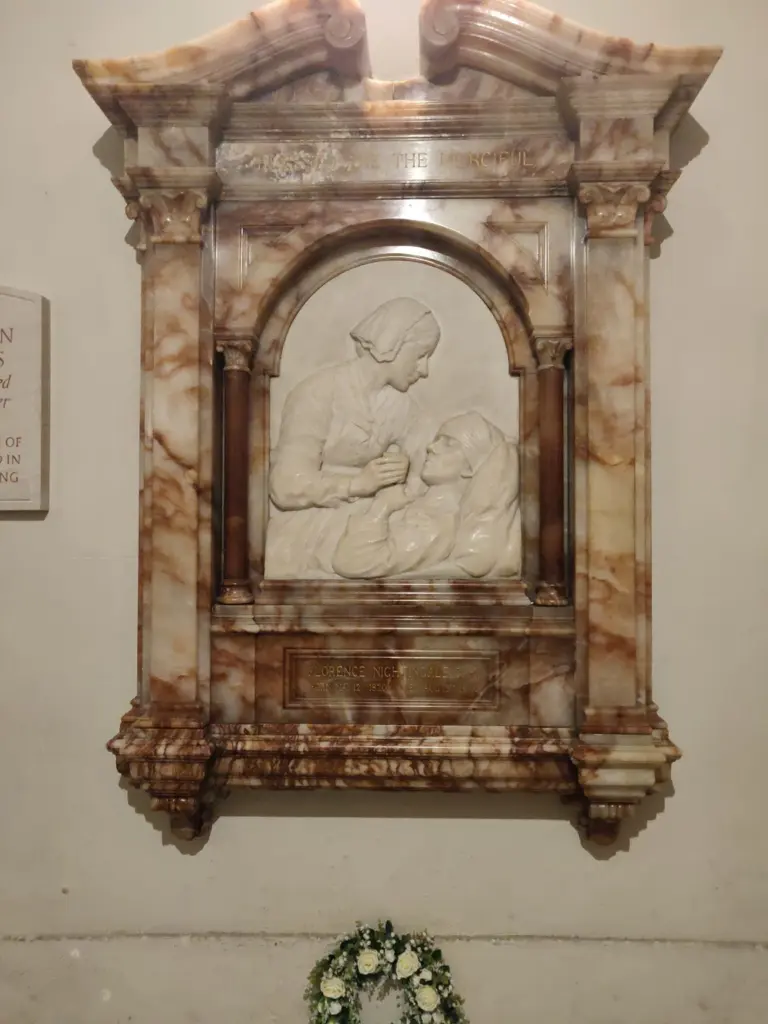
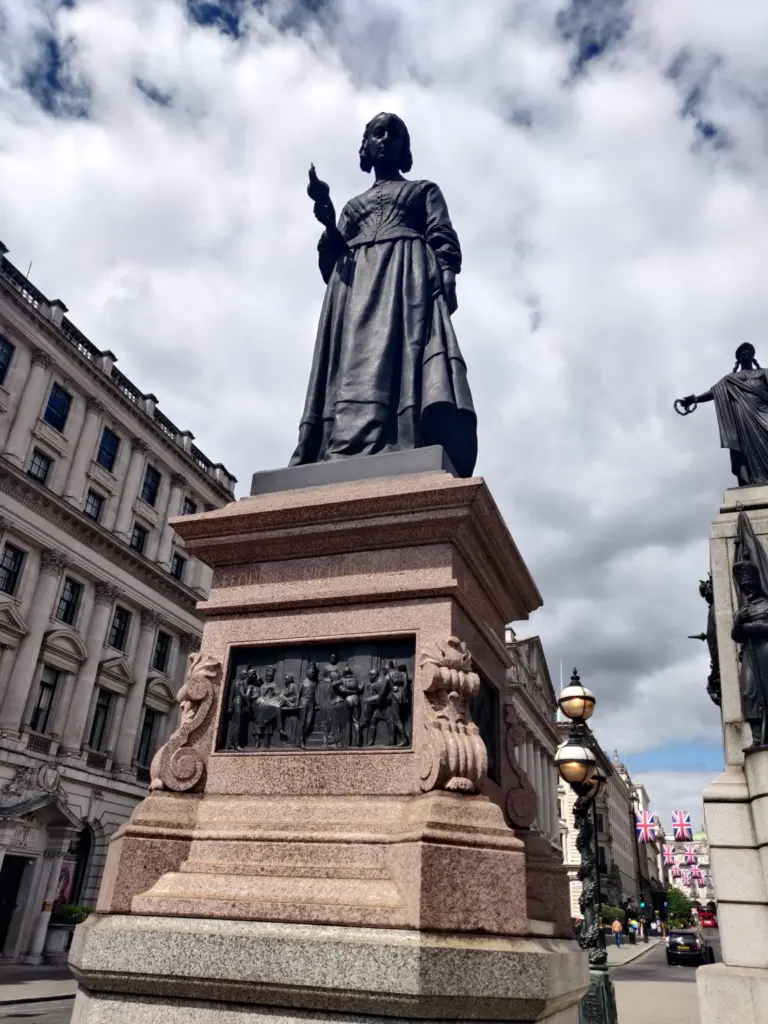
But Nightingale herself saw her role as a supporting one and did not consider herself a feminist. The Crimean Memorial in London is called — and here I rely on the work of other researchers — the first memorial where not monarchs and commanders-in-chief appeared, but ordinary soldiers. It is a collective memorial, and Florence Nightingale is one of its figures.
How has the perception of women in military service changed since then?
Of course, over the course of the twentieth century the situation changed dramatically. We know of many women who fought in both the First and Second World Wars — and there were many of them. These were not support roles but women carrying weapons alongside men and sometimes even commanding them.
There are quite a lot of monuments dedicated to women service members, but among them there is not a single major memorial. Most often these are monuments that recreate photographs. Unfortunately, this is a widespread but not particularly successful type of memorial.
In my opinion, a strong example is the Vietnam Veterans Memorial in Washington. It is minimalist and very restrained. It was proposed by Maya Lin and marked a major step in memorialization. Not everyone liked it, which is also normal. At first, the memorial was supplemented with a sculptural group of three men of different races. Predictably, the white man stands in front while the others stand behind his shoulders. They were portrayed in a very literal way. After that, women veterans’ organizations objected and said they needed their own monument. And again, in the sculptural group that was created to honor women in the military, women were represented as supporting figures — people shielding the wounded with their bodies and providing medical care.
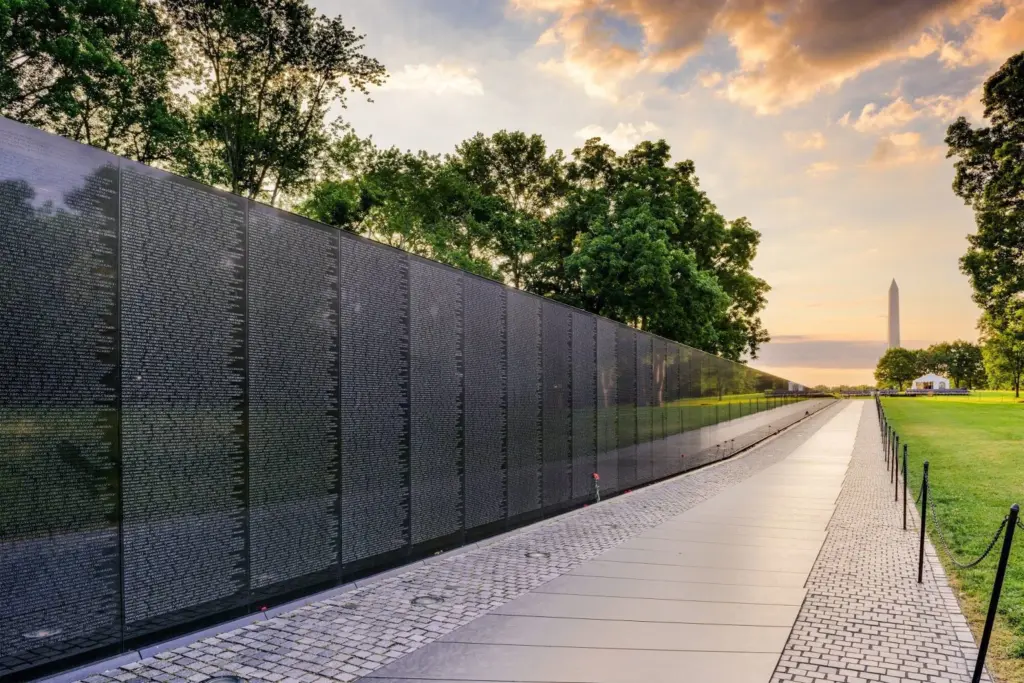
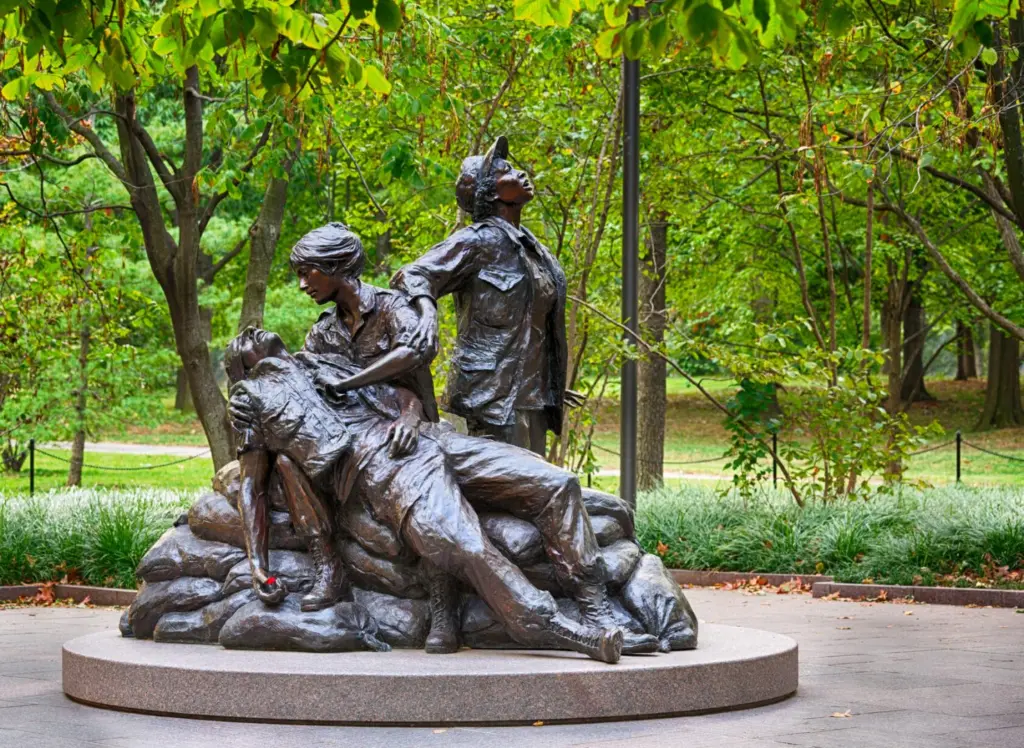
However, monuments to women still remain rare. Reality has changed far more than the language of memorials.
The war has been ongoing since 2014. At first the phrase woman service member still did not really exist in public discourse. Even though women were already serving alongside men. Has the situation changed since the start of the full-scale invasion and the large number of women joining the Defense Forces?
If we are talking about Ukraine, what matters greatly to me is that our rhetoric includes both defenders and women defenders. Before the full-scale invasion in 2022, women really were spoken about less, even though they already served alongside men. With the emergence of the @veteranka_ movement, women started being discussed more. Their equality to men in the military is being acknowledged.
But there is also the Soviet military tradition, which unfortunately has strongly influenced ours despite our attempts to move away from it. Even if we refer to your research, all the memorials mentioned are European or American. There is no example from the Soviet Union. As far as I know, most Soviet memorials were monuments to Alyoshas or the Motherland.
In Soviet memorial tradition, women were often present as abstract figures: the Motherland or Victory. These were metaphorical figures actively produced within Soviet tradition. If we think of large Soviet memorial complexes, alongside the central figure — Motherland, Victory, and so on — groups of soldiers were usually created, and among them we do see women. But again, women appeared as nurses, as people helping soldiers. In skirts, in military tunics. Literature portrayed them crawling toward the wounded, carrying them on their backs. That role was completely understandable and accepted. Memoirs were published, films portrayed this image too. But the idea of a woman soldier and of a monument dedicated to her simply did not exist. Maybe such examples existed somewhere — I don’t know — but it was never a central theme.
Again, this is a subconscious way of shaping perceptions of women’s role in the military. When Russia brought war into our home, many women had to break through this stigma. Do we already see this change in today’s commemorative practices? I understand that there are not many memorials in general, because the war is ongoing and people are still trying to hold back somewhat from building monuments. But are there any signs of change?
The changes in Ukraine have happened more in public space and rhetoric.
In the film Independence Day, there are several storylines, and one of them focuses on the military — with a woman in the leading role. The appearance of figures like this is very important to me. Gradually, something is changing. Although we still live inside stereotypes.
I also remember the post announcing the death of artist Margarita Polovinko. When the unit where she served reported her death, the text included the phrase: “Killed during a combat mission with a weapon in her hands.” They deliberately wrote that, because apparently it is not self-evident. If a soldier is a woman, it is somehow not obvious that she died with a weapon in her hands. So people feel the need to state it explicitly.
And perhaps that matters that posts like this appear. In the case of Margarita Polovinko, there were many reposts of a journalistic post about a “delicate flower who died.” Her brothers-in-arms said: no, not a delicate flower. She was our sister-in-arms, a warrior, a woman holding a weapon.
That idea of we are strong and you are beautiful still frames our perception. But I think major shifts in public understanding are taking place.
Today, as a way of processing grief, we create informal practices of remembrance. These are not monuments that remain in public space forever, but they are expressions of respect and cherished memory. These include murals, memorial festivals. For example those dedicated to Iryna Tsybukh (Cheka) — guided walks, and runs. There are many interesting initiatives being created specifically in memory of women. Will we be able to integrate these into the forms of commemoration that, I hope, we will adopt after the war — including into the creation of monuments?
That depends entirely on us. The first thing that comes to mind is the memorial festival for Iryna Tsybukh. Even these practices connected to the minute of silence are a continuation of her work. What matters greatly to me is that she spoke about a minute of honor. We are not simply remembering those who died — we are thanking those who are alive and defending our country today. And that should become a shared gesture. That sense of vitality is very important to me. I would not want it to disappear from the memory of Iryna Tsybukh.
The emergence of practices like these shows that we are actively searching for a new language of memory. The previous one no longer works for us. It now depends on us whether we manage to establish it. There are no guarantees, and we cannot make predictions. We live in a constantly changing reality, so we cannot confidently say: “Oh, this is already a trend.” For these practices to become a trend, we need to keep talking about them. Even this conversation is already a step forward. People who may never have thought about these questions before could begin reflecting on them and choose to support a particular practice. And perhaps next year someone will approach a memorial table and intentionally write the name of a woman who died on a card. Not only a man’s name, but a woman’s too.
When we participate in a practice, it becomes more likely that it will take root and give rise to a new trend.
Focus groups are important, and architectural competitions are essential when it comes to creating memorials, because public demand today is very high. Sometimes residents go directly to their local authorities and demand that a monument be built. A lack of experience and visual literacy creates space for outdated narratives to appear.
You made a very good point in your research: during war, women’s ways of thinking and living change. Women cannot continue living as they did before — not even after the war. Today, our women take on so many roles, even simply while waiting for their husbands to return from war. Many things will inevitably change for them. How do we prevent monuments to women from appearing with meanings that feel distorted and no longer relevant today?
You raised the most important issue: competitions and preparation for creating memorials. Very often, the first thing our communities think is that they need to find someone who knows how to work with materials. But creating a memorial means going through a long process. We need to understand what exactly this monument is about, what story it tells, and why we are placing it there.
I always use the example of the Reflecting Absence memorial in New York dedicated to 9/11. They spent two years writing only the technical brief for the competition. At first glance, everything seems obvious: a terrorist attack happened, many people died, there is a list of victims. But they still spent two years writing the brief. For the creators of that memorial, it mattered what exactly the memorial was trying to say. Eventually, they agreed that the memorial would be dedicated not only to the events of September 11 but also to another terrorist attack that had taken place at that location in the 1990s and killed six people. The memorial is not about the number of victims — it is about the fact that someone wanted to take innocent lives. It is about terrorism and its terrible consequences.
When we speak with representatives of communities, we ask: what do you want this memorial to be about? What story do you want to tell? Very often these questions leave people at a loss. A memorial is not about people dying. It may be about our grief, about resilience, about resistance, about how people resisted the enemy or survived occupation. The same event can tell very different stories. A memorial is a story we choose to tell, and that story can take a long time to shape. This is already memory work.
If we imagine a local community, people need to gather together and talk about what this memorial should be about, to train themselves to search for possibilities. And once participants begin sharing their visions, they realize that they see this story in very different ways. Often these are incredibly difficult conversations because the experience itself is painful. But people eventually begin to understand that they need to articulate values first. That is where we begin. When this process becomes normal for us, then we will be able to account for all the themes that cannot simply be left out.
In the comments under our materials, people immediately wrote that in Zhytomyr there is already a monument where a woman in military uniform stands alongside men. People are already signaling: “It’s not all as bad as you may be suggesting. We already have changes.” Perhaps, when creating that memorial, people came together, talked, and searched for a new form.
I think that today monuments do not so much tell stories as encourage interaction and invite people to feel something. That requires a great deal of time, involvement from different sides, patience, and the desire to make a memorial meaningful and layered. Not simply to build one because the community demands it, because funding was allocated. Or because elections are approaching. This topic can also become politicized.
How do we shape a new narrative about women in the military through cultural projects? For example, recently the documentary Cuba & Alaska was released about women paramedics. It shows that in modern warfare paramedics face no less risk — and perhaps even greater risk — given that the enemy prioritizes killing our medics. The film is also about sisterhood in the military.
These things are absolutely necessary, and it is wonderful that they are appearing because there is a need for them. Cuba & Alaska is definitely not a film that appeared because someone thought: “I should show women in the military, contribute something, raise a certain issue.” It came from a sincere desire to show real people without whom nothing moves forward.
The fact that we live in this environment and that films and books like this appear reshapes our landscape of meaning. Some things we already begin to perceive as normal.
By the way, there were already quite a lot of women in the military before 2022. Colleagues told me there was a major wave of women joining around 2018–2019, when women began to feel they could be comfortable in the army. I know women who have served since 2015. So reality itself is changing. And slow change is characteristic of any reality.
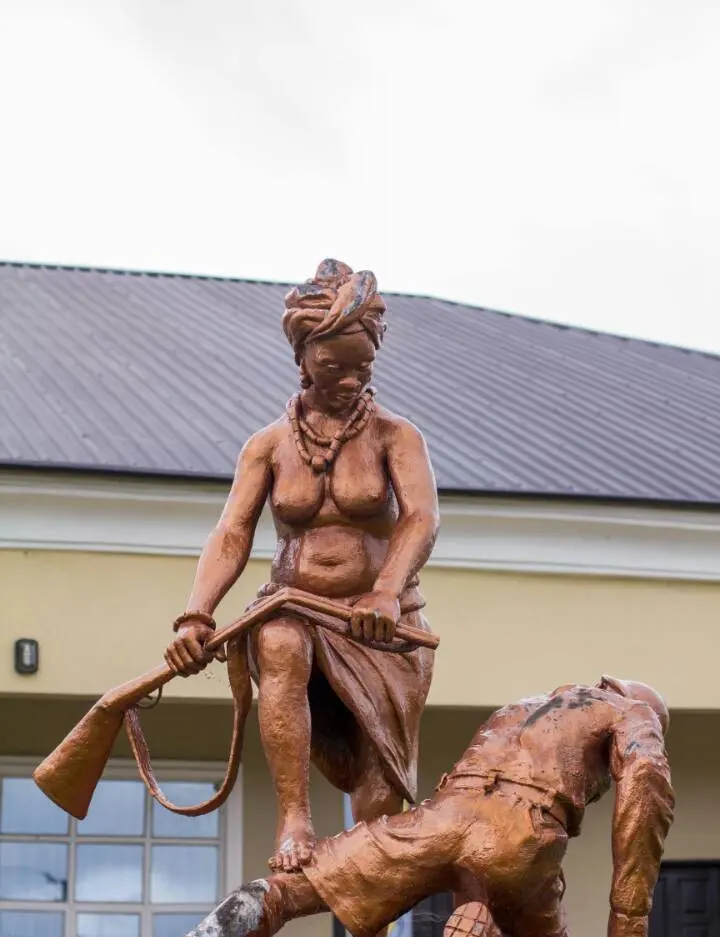
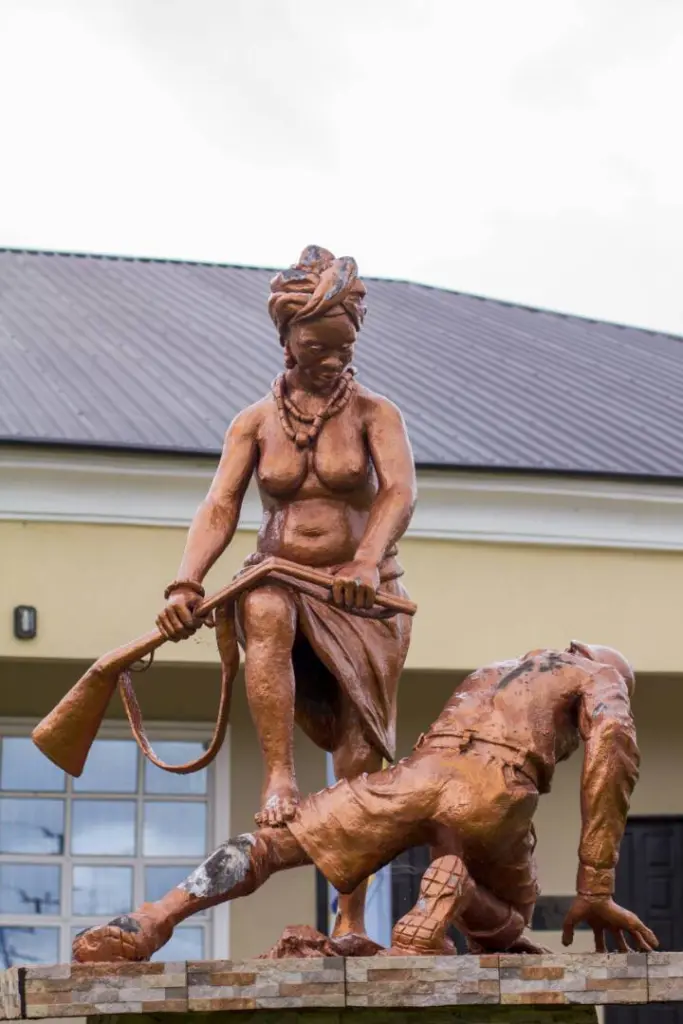
Let’s talk about the striking memorial shown on the cover of your research. It was created a long time ago, but it invites people to feel it and become participants in it. The memorial is dedicated to the events of the Women’s War in Nigeria. In 1929, it was women there who organized a large-scale uprising against British tax policy.
The memorial depicts a Nigerian woman, topless and dressed in traditional clothing, breaking the rifle of a soldier who came to her land to impose unjust taxes. To me, this monument says that a woman takes up arms only when there is a need to do so. When she has to defend her country and her family, not because she wants to prove her strength or take something from someone else.
When we found this memorial, we said to ourselves: “My God, this is it! Finally, a completely agentic heroine who wins and breaks the weapon.” And these women were not soldiers — they did not create an army. But they defeated those who came to them with weapons.
We did not find another memorial where a woman is represented with this much agency. It is a very beautiful composition. The woman breaks the rifle and rests her foot on the leg of the British soldier, who will ultimately break too because he encountered this woman.
It is a very powerful message: a woman takes up arms only when something she values is under threat — and drives out the colonizers.
You and the @veteranka_ movement dedicated your research to women who were killed.
We wanted this not to become an abstract journey where we searched for women’s memorials and concluded that they are imperfect but at least they exist. We are part of the Russian–Ukrainian war; we are a society living through this war.
For us, it feels natural to quote the fallen poet Maksym Kryvtsov: for us, war is names. So naturally, while discussing this material, searching and deciding what exactly we wanted to say, we were thinking about Ukraine and about those we have lost.
We decided that if we were searching for answers together with @veteranka_, then we would at least name two people. Of course, there are far more names. As a memory culture platform working with art, we chose Margarita Polovinko. @veteranka_ proposed the name of Daria Lopatina.
It matters deeply to us that this is about real people. We are not discussing abstractions but speaking about specific people whose memory matters to us.
This is one of the key messages and perhaps one of the defining features of the Ukrainian culture of remembrance we are creating here and now: names.
Our task is not to let them be forgotten.
Listen to the full interview in the program Memorialization.
Interview by Nataliia Nekypila.