Autumn 1989. The Kharkiv branch of the People’s Movement announces a gathering in Molodizhnyi Park on what was then Pushkinska Street. People are asked to come and dig holes — supposedly for planting viburnum. Though no one knows what is in fact happening,
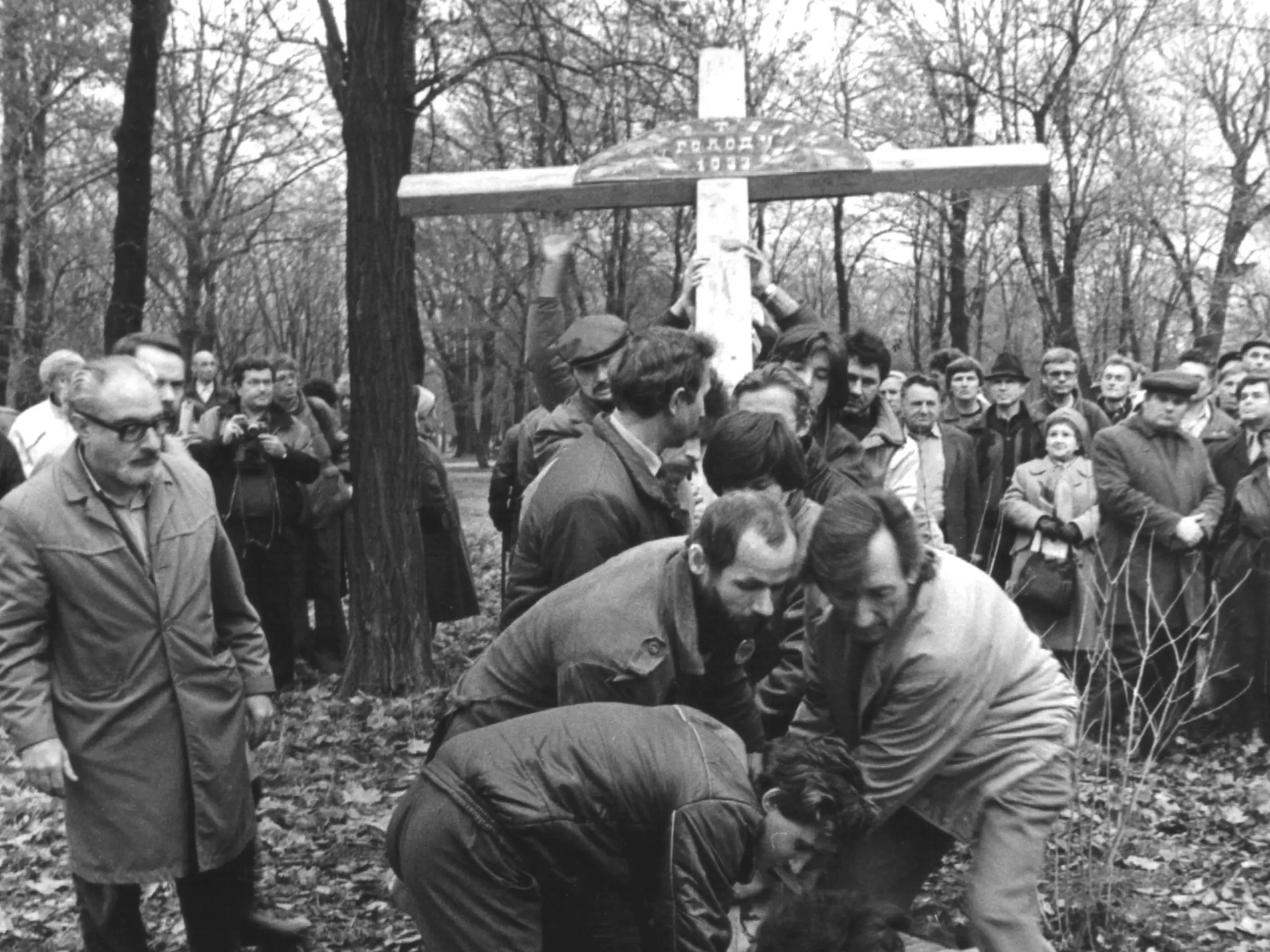
Suddenly, a car pulls up. Someone shouts, “Guys, we urgently need twenty people!” People run, not understanding why or where. A wooden cross is taken out of the car. Only then are they told that it is a memorial cross for the victims of the Holodomor. A priest invited from Lviv conducts a memorial service. On either side, the police stand silently, watching everything.
Volodymyr Pasichnyk, after whom one of Kharkiv’s streets is now named, was then the head and co-founder of the People’s Movement of Ukraine. He also established the Kharkiv group of the Ukrainian Helsinki Union and the regional branch of the Taras Shevchenko Ukrainian Language Society. He was the one who initiated the installation of the first memorial cross in Ukraine dedicated to the victims of the Holodomor.
“How long my father had nurtured this idea—no one knew: neither I, his son, nor my mother. We were used to living under constant KGB surveillance. They often stood literally outside our door, and my father, going out on business, would simply greet them and walk on,” recalls his son, Stepan Pasichnyk, a Kharkiv-based Ukrainian theatre director, actor, and Honored Artist of Ukraine.
The question of why Volodymyr Pasichnyk did not tell his family about his plans is rhetorical. To find logs for the cross, he traveled across almost the entire Kharkiv region, and only managed to find suitable ones in the Liubotyn forestry. As he himself later recalled, he was asked what he needed such a large cross for. He replied that many of his relatives were buried in a cemetery.
“My father dragged those logs from Liubotyn to Kharkiv. Fortunately, a vehicle picked him up and brought him into the city. After that, for quite some time — perhaps a month, maybe less — he worked with an axe, finishing and crafting the cross with his own hands,” Stepan says.
Volodymyr Pasichnyk called his son Stepan — who was already an actor at the Taras Shevchenko Kharkiv Academic Drama Theatre — at six in the morning and gave him an address, telling him to come within half an hour. Only when he saw the cross in the truck did Stepan finally understand what was about to happen:
“We were driving along what was then Pushkinska Street, now Skovorody Street, and we didn’t turn onto Artem Street — now Yaroslav Mudryi Street. I think my father’s intuition kicked in. As it turned out later, that entire direction had been blocked. There were no mobile phones back then, no way to contact anyone. The entrance to the park was blocked with concrete slabs. The whole street was under heavy police guard.
But by the time they ran from that entrance to Molodizhnyi Park from a nearby street, the cross was already in place within three minutes. The guys lifted it onto their shoulders, carried it to the dug hole, and installed it. By the time the police and other authorities arrived, the cross was already standing — firmly set and secured.”
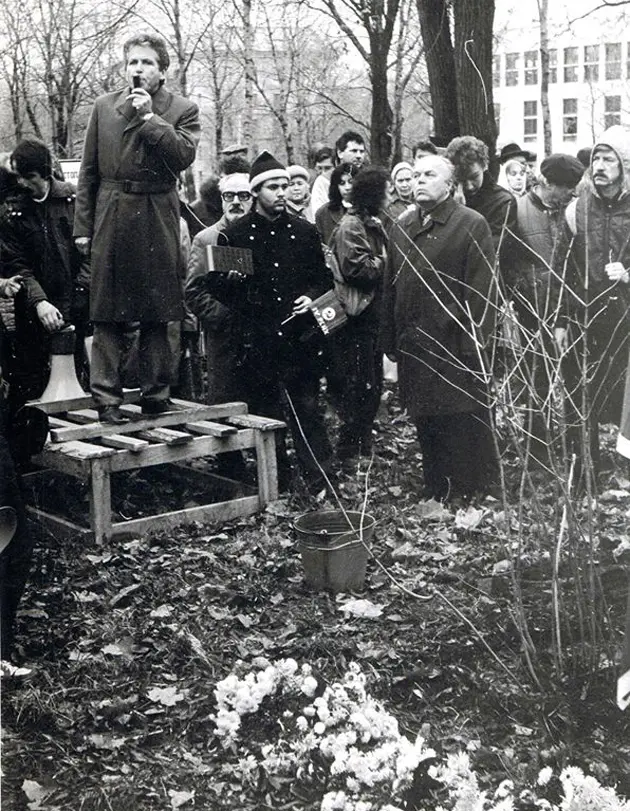
The location for the cross was not chosen by chance. As Volodymyr Pasichnyk explained, Molodizhnyi Park is located on the former German Street (later Pushkinska street, now Skovorody Street). It is close to an old city necropolis where prominent Kharkiv residents were buried. In the 1930s, the bodies of those who died during the Holodomor were secretly brought here. Burial brigades placed them between old graves, without any markers.
In the 1970s, Soviet authorities destroyed the cemetery, turning its eighteen hectares into a recreational area with a stage, cafés, and a cinema. This decision did not gain public support. However, during perestroika, people came forward to restore the memory of the Holodomor victims. They chose to place a memorial right in the city center—where their graves had once been.
The cross was consecrated by a priest from Lviv, invited to Kharkiv by members of the People’s Movement. A rally gathered. Throughout the event, police officers observed everything.
“There were really a lot of people. And when everyone began to leave, I stayed by the cross overnight. Around six in the morning, I saw several platoons approaching — about forty to fifty cadets. There were also men in civilian clothes with large handheld radios. They stopped about fifty or sixty meters from the cross, and I realized I was standing there alone. I got scared because I didn’t know what to do.
It was starting to get light. Then an elderly man jogging past caught my eye. I ran up to him, gave him our home number — 47-75-31 — and asked him to call and tell people to come. He looked at me and asked, ‘What are you doing here?’ I replied, ‘What do you mean? I’m guarding the cross.’ And he said, ‘The cross doesn’t need guarding. The cross will guard itself.’ I remembered that for the rest of my life,” Stepan says.
After that, he recalls, people kept watch by the cross for a long time: “Five to seven people at a time, constantly.”
When asked if information about the installation had spread in advance — since quite a lot of people showed up — he says that no one knew anything beforehand. “Even now I don’t know the names of those who were aware. Three or four people knew,” he says.
The decision was made by a narrow circle. He still does not understand how the information leaked to Soviet authorities, who appeared to be fully prepared. “How the authorities and security services found out and why they were waiting at that exact moment — I still don’t know.”
The memorial cross for the victims of the Holodomor was repeatedly damaged and vandalized. It had originally been intended as a temporary marker, with a full memorial to be built later on that site.
However, in 2007, city authorities opposed the construction of a memorial in Molodizhnyi Park. The chief architect of the city at the time, Serhii Chechelnytskyi, explained the position as follows: “If we agreed to create Molodizhnyi Park, then let’s make it a park. This is what happened: we removed the cemetery, called it Molodizhnyi Park. And now we are turning it back into a cemetery.”
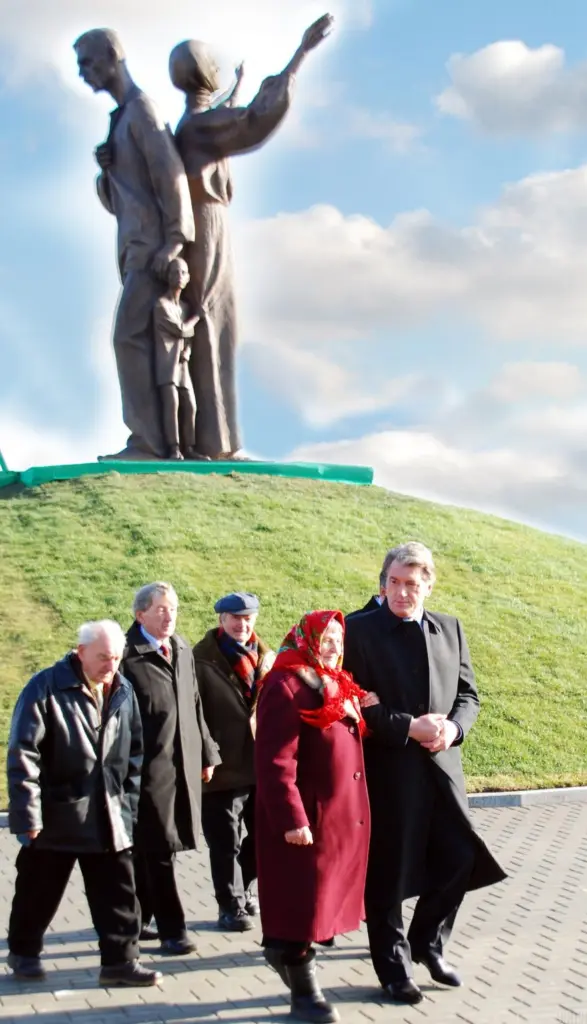
The memorial was eventually built — but not in Kharkiv. On November 19, 2008, the Holodomor Victims Memorial was solemnly opened in the village of Cherkaska Lozova in the Derhachi district. It was personally inaugurated by the President of Ukraine, Viktor Yushchenko. Three witnesses of the tragedy, along with officials, clergy, and members of the public, attended the ceremony.
The memorial stands on elevated ground, clearly visible from the Kharkiv–Moscow highway. The central bronze composition depicts a Ukrainian family in a moment of despair. The father looks north — toward Russia, from where the policy of destruction came. The mother raises her hands in prayer, and the children cling to her, seeking protection.
A museum was opened next to the memorial on November 24, 2018.
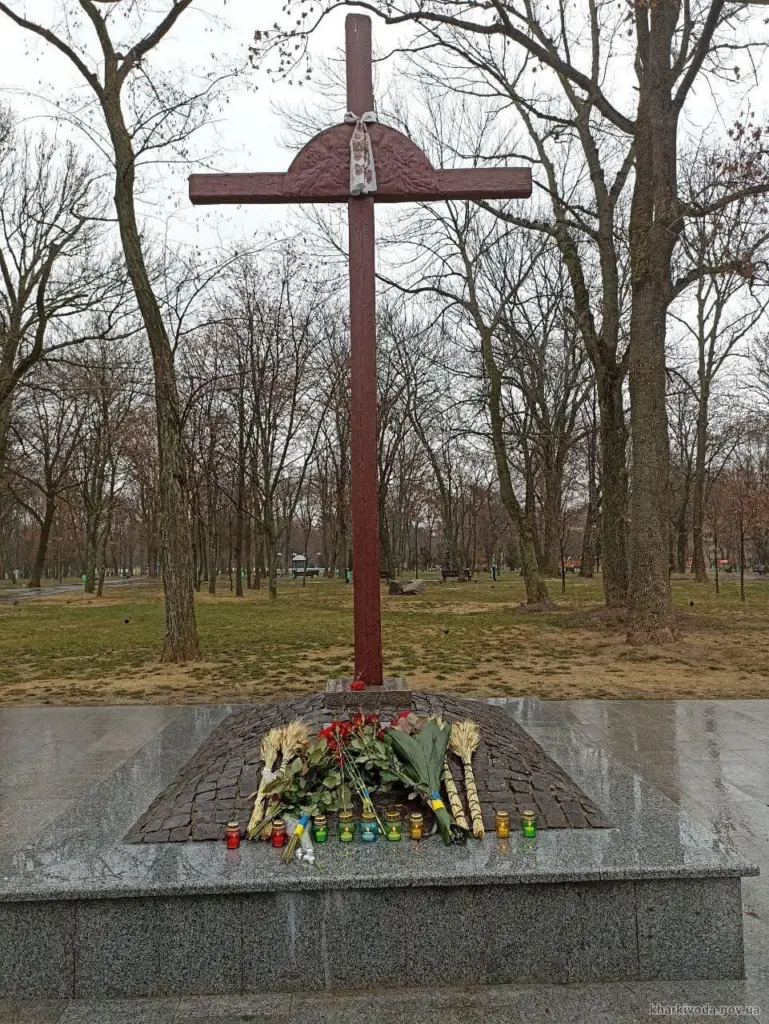
The cross crafted by Volodymyr Pasichnyk with his own hands still stands in Molodizhnyi Park today.
Tetiana Khoronzhuk