Kharkiv is a Ukrainian city. It has never been entirely Russian-speaking. These seem like self-evident, widely acknowledged facts. Yet some people still claim the opposite. That’s why, for International Mother Language Day, we decided to once again revisit the history of our city’s Ukrainian identity. Not to fuel division or speculate on language issues, but to finally put things in their proper place.
We spoke with Ukrainian linguist Larysa Masenko, Doctor of Philology, a member of the Academy of Sciences of Higher Education of Ukraine, professor, and leading researcher at the Institute of the Ukrainian Language of the National Academy of Sciences of Ukraine.
— Ms. Larysa, Kharkiv is officially dated to 1654. Today, however, that date is debated, as earlier settlements existed on this site. But can we prove that Ukrainians have lived here since the beginning and spoke Ukrainian?
— In fact, there’s nothing to prove. It’s an axiom. Kharkiv was founded by Cossacks and settlers from nearly all regions of Ukraine. Russians came later. The city became a stronghold of the Russian Empire, and Russification followed—but that’s another story.
In the 17th century, when Kharkiv was founded, most people in Ukraine were peasants, as Yurii Shevelov points out. Naturally, they spoke Ukrainian. Of course, it wasn’t the same language we speak today—language is always evolving. But the fact that it was a Ukrainian-speaking environment is confirmed by a vast body of folklore preserved from that time and even earlier.
— And what about the surnames of registered Cossacks?
— Surnames are another indicator of Slobozhanshchyna’s Ukrainian character. Surnames were still forming at the time. But if you look at Cossack registers from Sloboda Ukraine, most have Ukrainian roots and suffixes. Later, both imperial and Soviet authorities tried to Russify them as much as possible. Russian suffixes were added to native Ukrainian roots. This happened in Kharkiv as well. Take the common surname Shevtsov: originally, it was Shvets, a Ukrainian word. In Russian, you’d say sapozhnik or bashmachnik. Despite all this, Ukrainian remained remarkably strong in Slobozhanshchyna. In fact, Slobozhanshchyna and Poltava became the cradle of the modern Ukrainian literary language.
— Is that why the Kharkiv school of romantics emerged?
— In many ways, yes. The Kharkiv Romantics were among the first major phenomena in the development of literary Ukrainian. Kharkiv University played a key role. Its students, graduates, and professors first took an interest in folk culture and then began writing literary works in Ukrainian. Of course, the Romantic era and its ideas had a strong influence. But this was a major step forward—one that paved the way for a broader Ukrainian national revival.
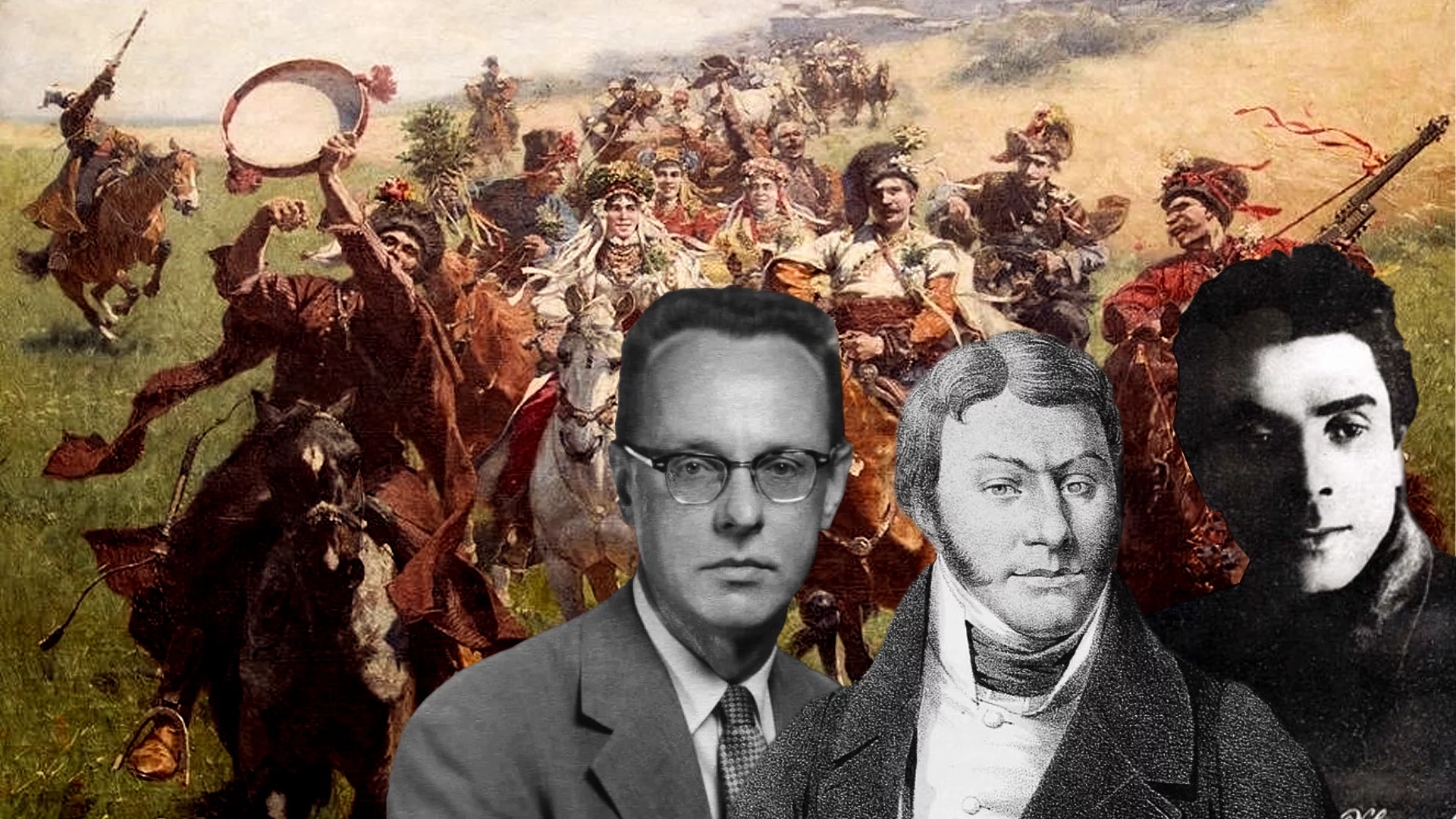
Among them were Hryhorii Kvitka-Osnovianenko, a Kharkiv native and founder of Ukrainian sentimental prose; Mykola Petrenko, author of the romance “I Wonder at the Sky,” still sung today; Mykola Kostomarov, who wrote The Book of the Genesis of the Ukrainian People; as well as Izmail Sreznevsky, Amvrosii Metlynsky, Levko Borovykovskyi, Ivan Roskovshenko, Opanas Shpyhotskyi, Oleksandr Korsun, and Yakiv Shchoholiv. These are names you’ve likely heard before.
— But did they actually use Ukrainian in everyday life? It was a time when people in high positions were often forced to speak Russian.
— That’s a complex question. Russian was certainly present in their lives. Even Kvitka-Osnovianenko wrote in Russian, but those works don’t carry the same literary weight as his Ukrainian ones. Because even those who were forced to use Russian remained Ukrainian in mentality. Otherwise, why would this entire group of intellectuals devote themselves to developing Ukrainian? We tend to think cities were fully Russified, but many townspeople and landowners still used Ukrainian. This is, by the way, an area that still needs deeper research.
— And what about the late 19th century, after bans like the Valuev Circular and the Ems Ukaz? Did Ukrainian spirit persist in Kharkiv?
— The late 19th and early 20th centuries were a time of strengthening Ukrainian identity and consciousness. In Kharkiv, among students, a nationalist movement began to take shape. It was here that Mykola Mikhnovsky founded the Ukrainian People’s Party—the first political party in the Dnipro region to call for full independence, not just autonomy.
— Then came World War I, the communists, and Kharkiv became the capital of occupied Ukraine…
— It was an extremely turbulent time. We wouldn’t have enough time even in a day to describe everything that happened in those years. Yes, Kharkiv was occupied. But would the policy of korenizatsiya—so-called Ukrainization—have been implemented if there had been no basis for it? Clearly not. There was a “Red Kharkiv.” But that same Kharkiv became a center of Ukrainian modernism. A whole generation of talented artists worked there. Even those who sympathized with communism continued to develop Ukrainian culture—and later paid for it with their lives.
Among them were Les Kurbas and his theater, Mykola Khvylovy, Maik Yohansen, Mykhail Semenko, and many others who contributed to cultural and national revival.
We also have recollections from Lviv academician Kyrylo Studynsky showing that Ukrainian wasn’t imposed in Kharkiv—it spread naturally. When he first visited in the early 20th century, he heard Ukrainian only in the homes of Professor Sumtsov and Khrystia Alchevska. But when he returned twenty years later, he wrote: “You hear Ukrainian everywhere in Kharkiv. Times change.”
— That was also when the first unified Ukrainian orthography was created in Kharkiv, right?
— Exactly. I don’t want to whitewash Mykola Skrypnyk, but he was a strong supporter of Ukrainization and initiated the Kharkiv orthography. He acted wisely, entrusting its development to leading scholars from both Soviet Ukraine and Western Ukraine (then under Poland): Ahatanhel Krymsky, Leonid Bulakhovsky, Olena Kurilo, Oleksa Syniavsky, Yevhen Tymchenko, Mykola Hrunsky, Vsevolod Hantsov, Mykola Nakonechny, Hryhorii Holoskevych, Borys Tkachenko, and others. Most of them were later repressed by Stalin’s regime. The orthography was never fully implemented. Within a few years, “bourgeois nationalist” elements were removed.
— And what about Shevelov? His role is also remarkable for Kharkiv.
— What’s most interesting is that he wasn’t ethnically Ukrainian—his father was German. Yet he consciously chose a Ukrainian identity and remained committed to it all his life. He studied philology, was an outstanding student, and was invited to postgraduate studies by two professors—Oleksandr Biletsky and Leonid Bulakhovsky. He chose linguistics and later produced hundreds of groundbreaking works that remain essential for linguists today.
Most importantly, he dismantled the imperial myth of the “three brotherly peoples.” He demonstrated that there was never a unified East Slavic nation and showed how Russia appropriated Ukrainian history. Soviet officials attacked him, and his works were banned.
Yet he deeply loved Kharkiv. After Ukraine gained independence, he visited the city again. In his memoirs, he once more challenged the myth of Kharkiv as entirely Russian-speaking. In the 1990s, riding in a taxi with a colleague, he noticed that the driver began inserting Ukrainian words into his speech as they talked. By the end of the ride, as Shevelov recalled, about a third of the young man’s speech was already in Ukrainian. It shows how naturally Ukrainian can return and spread in Kharkiv.
In his final days, while delirious, he often repeated: “Let’s go to Kharkiv.” This was recalled by Oksana Miyakovska-Radysh, who was with him in the hospital.
— That’s truly moving. Yet Kharkiv long carried the label of a Russian-speaking city. And some people still insist it always was. How do we convince them otherwise?
— You don’t. You can’t change such people’s minds. But it’s mostly the older generation—those who didn’t live through the 1920s or know what happened in the 1930s. It’s better to avoid such debates for the sake of your mental health. Let them say what they will—we should focus on our own work.
We need to work with young people. And current trends are very encouraging. After the Revolution of Dignity, and especially since the genocidal war unleashed by Vladimir Putin, many Ukrainians who used to speak Russian in daily life have switched to Ukrainian. Ukrainian is reclaiming urban space, pushing Russian out. Many now see Russian as the language of the enemy—something inappropriate to speak. And this, just like Shevelov felt after speaking with that Kharkiv taxi driver, gives me a sense of uplift.
Author: Tetiana Khoronzhuk